


Choosing a watch strap always starts with one measurement: the lug width. This distance between the two lugs of the case, expressed in millimetres, determines the width to order — and nothing else does. A one-millimetre error makes fitting impossible.
This guide explains how to take that measurement accurately, which length and buckle to choose, how the attachment systems work, and which materials suit which use. It ends with the lug width of 272 watch models.
Since 2010, we have been advising collectors and enthusiasts on the choice of their straps. A question about your watch? Our team is available on +33 9 80 84 88 08.
Measuring a watch strap: lug width, buckle, length
Attachment systems: spring bars and Quick Release
Changing a strap: removal and fitting
Materials: leather, rubber, nylon
Matching colours
Pin buckle or deployant clasp?
Lug width by brand: 272 models
FAQ — Size and dimensions
Our collections
Measuring a watch strap: lug width, buckle, length
Measuring the lug width
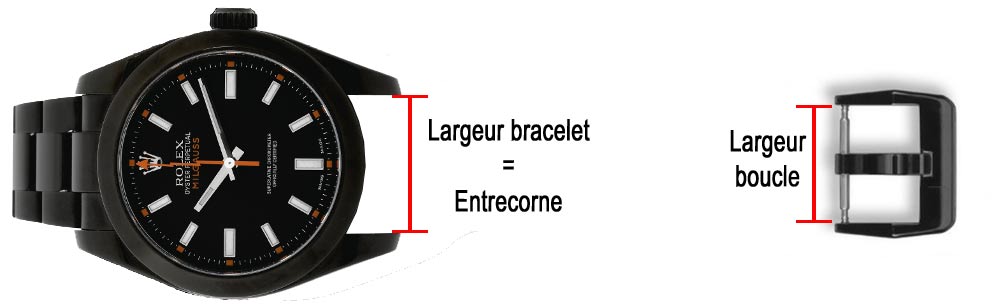
The key measurement of a strap is its width at the attachment point. It is taken on the watch case itself, between the two lugs that hold the strap. This distance is called the lug width.
Measure the exact gap with a vernier caliper, or failing that with a ruler. Standard widths are 16, 18, 20, 22 and 24 mm. 26 mm also exists, on the very largest cases. Sizes of 19 and 21 mm remain uncommon.
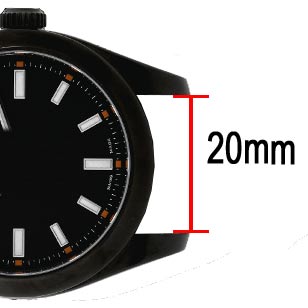
An example: if your watch measures 20 mm between the lugs — the case with almost every Rolex — choose a strap from the 20 mm category.
One piece of advice avoids most mistakes: do not measure your old strap, measure the gap on the watch. A strap deformed by wear, or wrongly sized in the first place, would lead you to order the wrong width.
The buckle width
The buckle is measured the same way, on its inner section, where the strap is held by a spring bar. It is almost always narrower than the strap, by 2 mm.
A 20 mm strap therefore takes an 18 mm buckle: this is referred to as 20/18. A 24 mm strap takes a 22 mm buckle, or 24/22.
This measurement matters little when ordering: our straps are supplied with their original buckle. It becomes useful only if you wish to reuse your current buckle — in which case measure it precisely beforehand.
The length
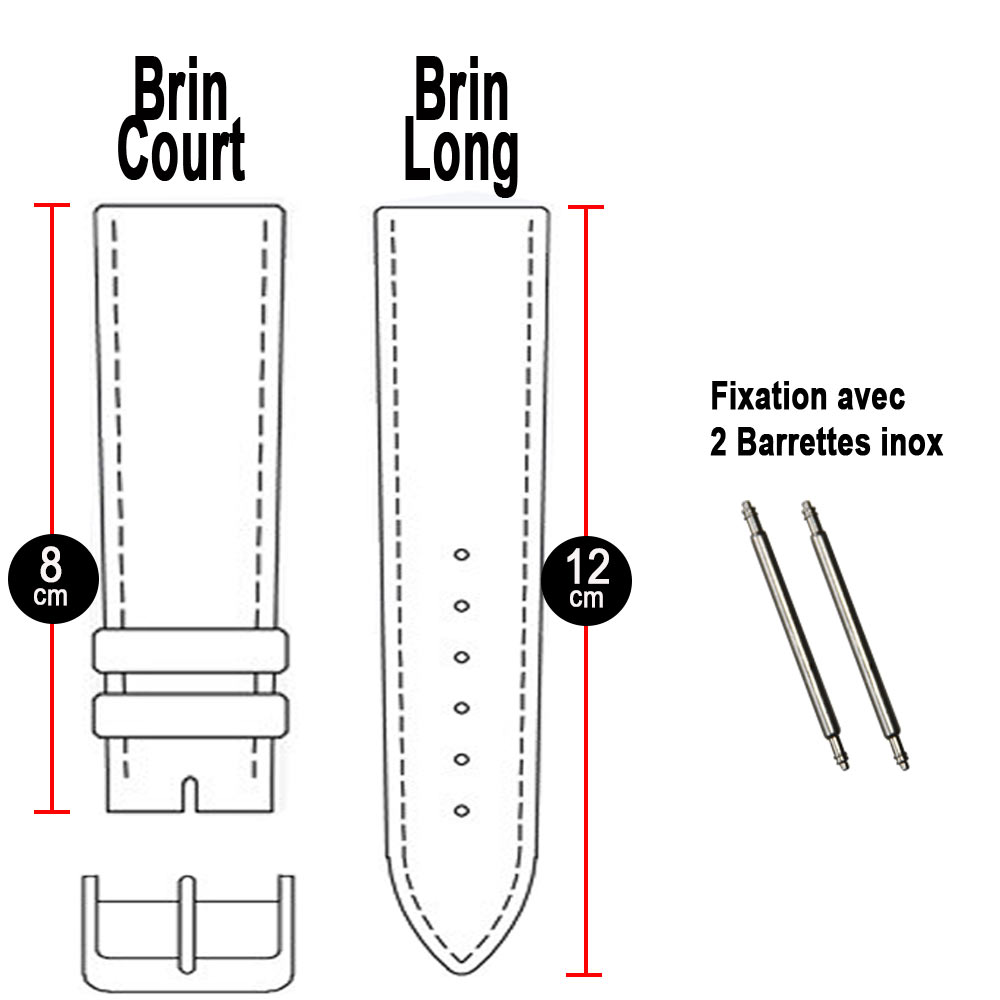
A standard strap is around 20 cm in total: an 8 cm short section and a 12 cm long section. This length suits the vast majority of wrists.
Other formats exist across the ranges: Medium at 18 cm for slim wrists, XL at 22 cm for larger wrists or for wearing over a sleeve.
Attachment systems: spring bars and Quick Release
Spring bars
Straps are attached to the watch by spring bars, metal rods housed between the lugs. Always choose marine-grade stainless steel: ordinary steel oxidises and eventually seizes.
Check their condition every time you change strap — bent, seized or pitted, they must be replaced. A tired spring bar that gives way means a watch on the floor.
New strap = new spring bars
The standard diameter is 1.5 mm. We recommend 1.8 mm stainless steel, more robust, particularly on NATO straps where the entire load rests on the bars. The length matches the lug width: a 20 mm watch takes 20 mm spring bars.
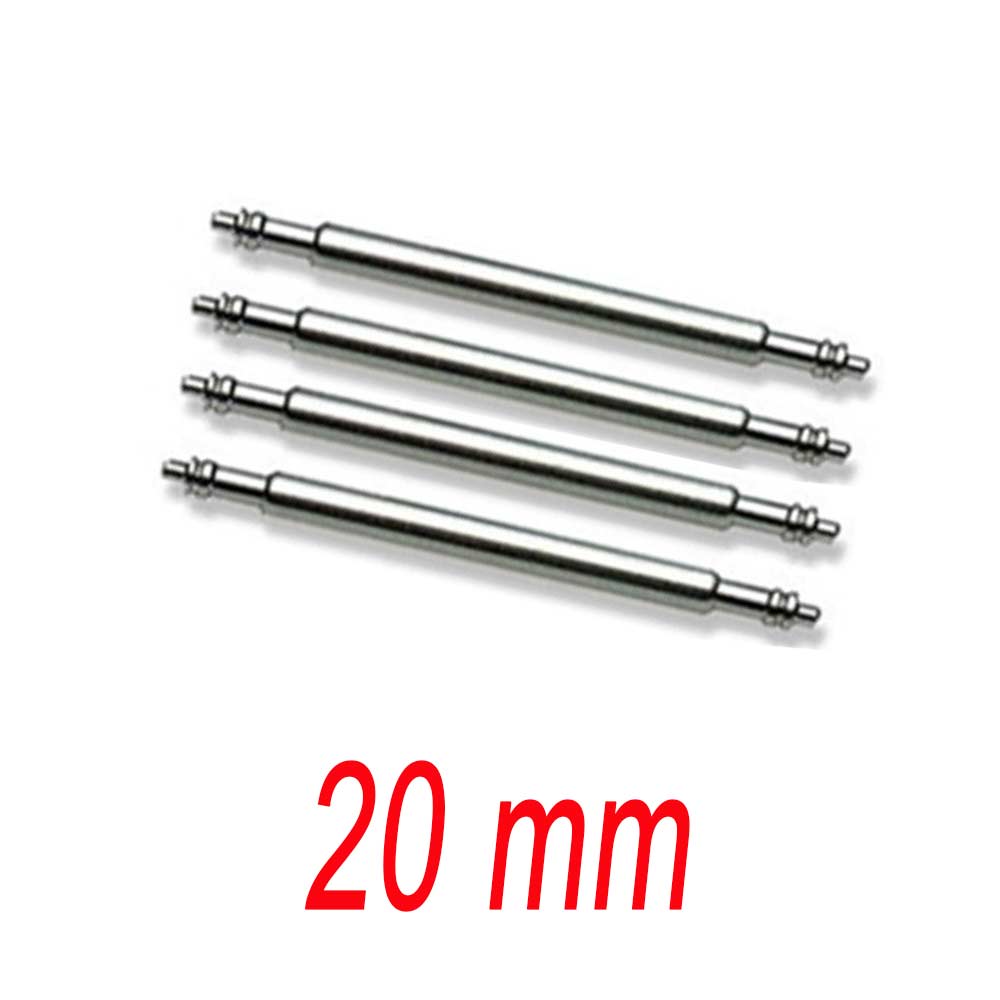
Set of 4 reinforced 20 mm stainless steel spring bars
The Quick Release system
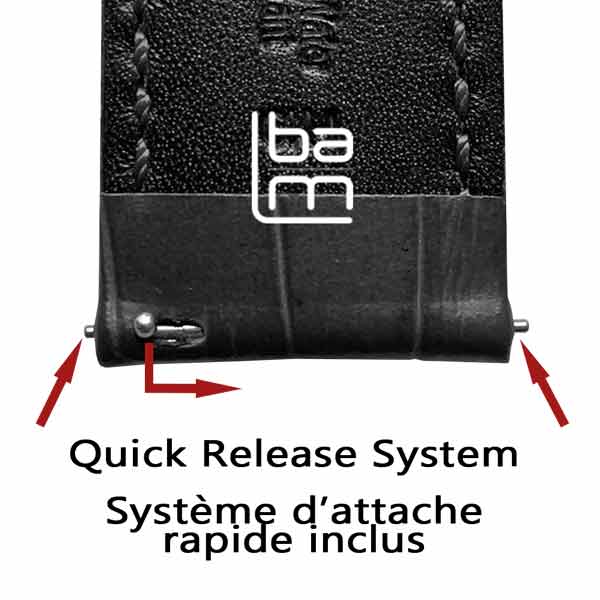
Some straps include a quick-release fitting. A small stainless steel tab, operated with a fingernail, compresses the spring bar and frees the strap without any tool. The Hirsch range now fits this system to most of its models, with robust, well-finished bars.
One important caveat, and it concerns measurement: the size must be exact. A 20 mm Quick Release strap fits correctly only on a lug width of precisely 20 mm. If your watch measures 21 mm, the attachment will not hold.
In that case there is a solution: carefully remove the tab with pliers, take out the bar, and replace it with a standard stainless steel spring bar of the right size. The strap becomes compatible again.
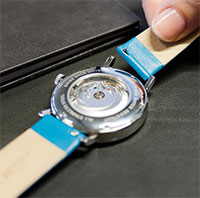
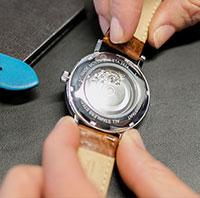
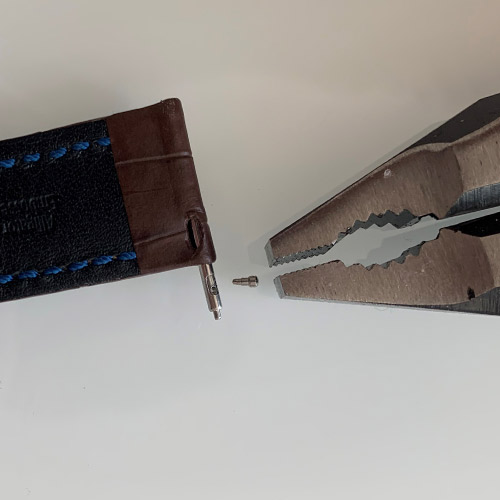
To see the operation in real conditions, our video guide covers removal on every type of attachment: removing a watch strap.
Changing a strap: removal and fitting
Removing a strap requires a fine-forked tool. Never use a screwdriver: the flat blade slips and scratches the lugs, and this is the single most common cause of damage to a case.
Be wary too of cheap tools sold for a few euros. Poor-quality steel breaks quickly, and a fork that is too thick damages the strap as much as the watch. The professional reference remains the Bergeon 6767F tool, made in Switzerland, whose stainless fork is both very fine and durable.
The operation takes only a few movements: place the watch face down on a soft surface, slide the fork between the strap and the lug, hook the spring bar, compress it until it releases, then swing the strap clear. The technique varies depending on whether your lugs are drilled — the tool enters from the outside — or solid, where the bar is reached from the inside.
Our detailed guides cover every configuration on video: removing a watch strap for removal, and fitting a NATO strap for installation.
Materials: leather, rubber, nylon
The material transforms the look of a watch as much as its colour. It also determines how long the strap lasts and how comfortable it feels. Here is what genuinely sets the families apart.
Tanning, the first mark of quality
Before the material comes the process. Entry-level straps use chrome-tanned leather: stiff, short-lived, and a source of allergies in contact with the skin.
Vegetable tanning, used by Hirsch and Arezzo, uses no chemicals but tree barks — oak chiefly, one of the richest in tannins. Drummed for several months, the hides remain naturally hypoallergenic. The resulting leather is more supple, and the pigments used are natural too.
It is an old process, longer and more costly. It is also what separates a strap that ages well from one that hardens within six months.
Classic leathers and nubuck
Calf, veal, buffalo: standard leathers are built from bonded then stitched layers. The lining must be hypoallergenic. Structures are either padded — a water-repellent foam rounded beneath the surface layer — or flat, depending on the style.
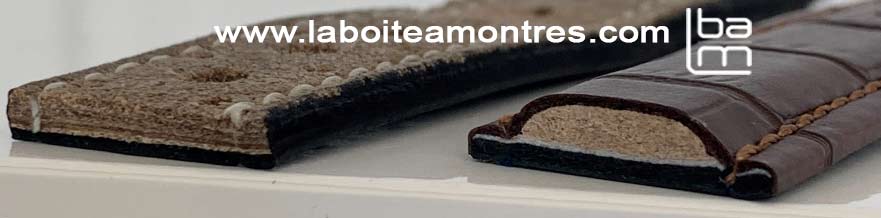
The edge finish distinguishes two schools. Turned edge, where the surface wraps around the edges and folds underneath: the classic, padded register. Cut edge, where the stacked layers are cut vertically then brush-sealed with a thin latex coating against moisture — often paired with vintage Italian stitching.
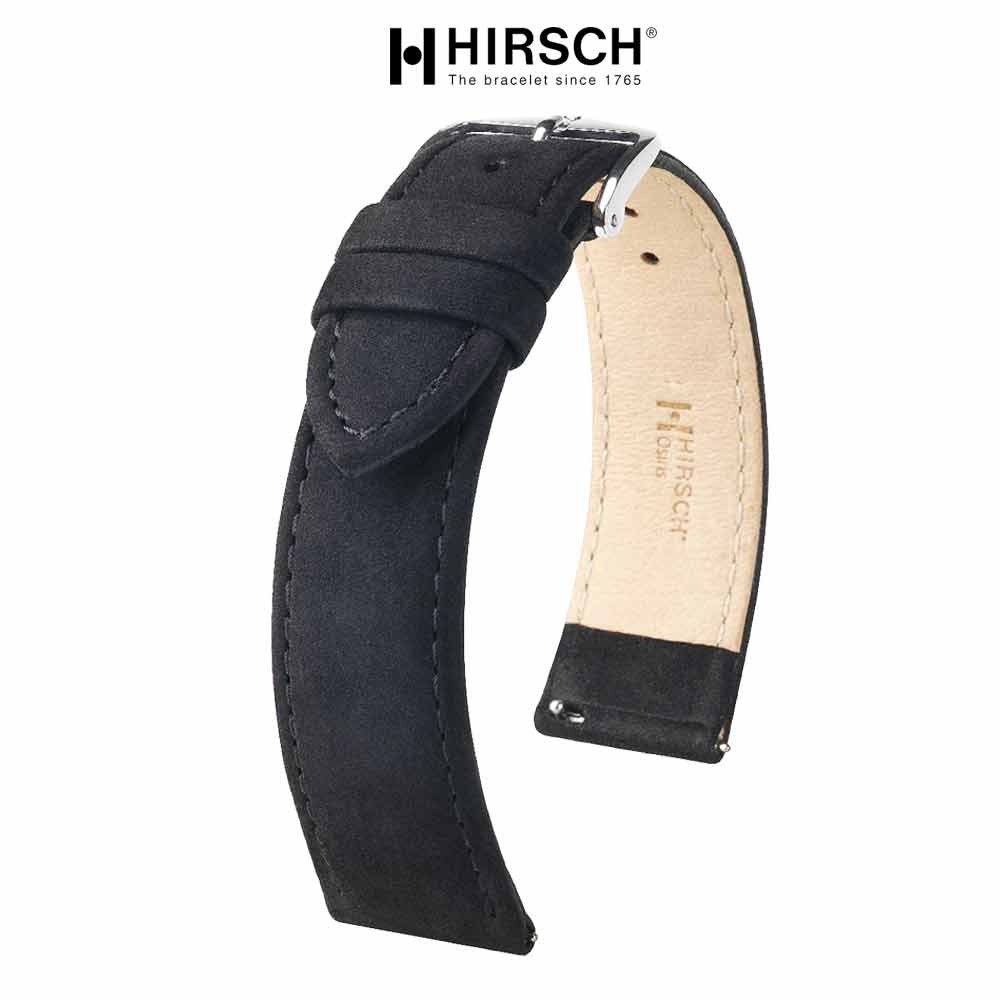
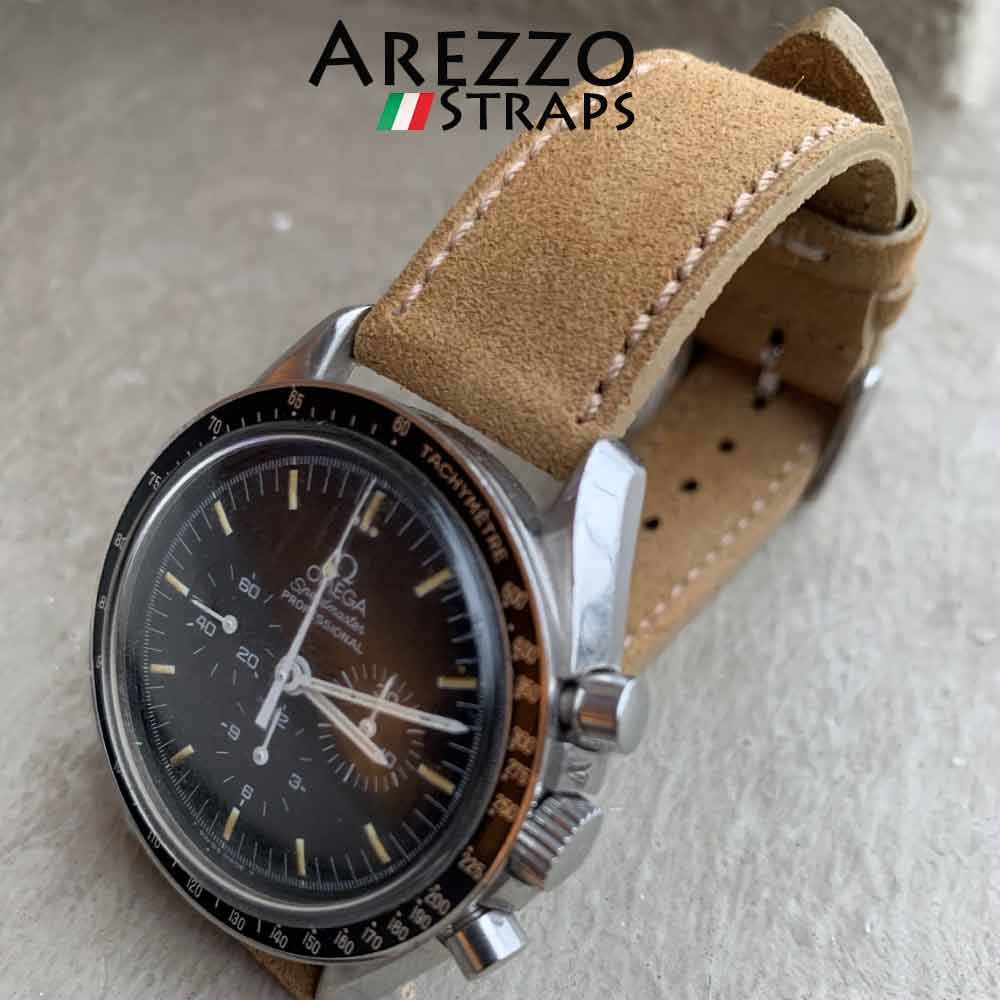
Nubuck is obtained by sanding the surface of a calf or buffalo hide. Velvety to the touch, matt and warm in appearance, fine and light in structure. It softens a steel case like no other material. Two references from the range: the Hirsch Osiris, nubuck surface with smooth leather lining, and the Arezzo Nubuck Slim, vegetable-tanned on both faces.
Embossed and precious leathers
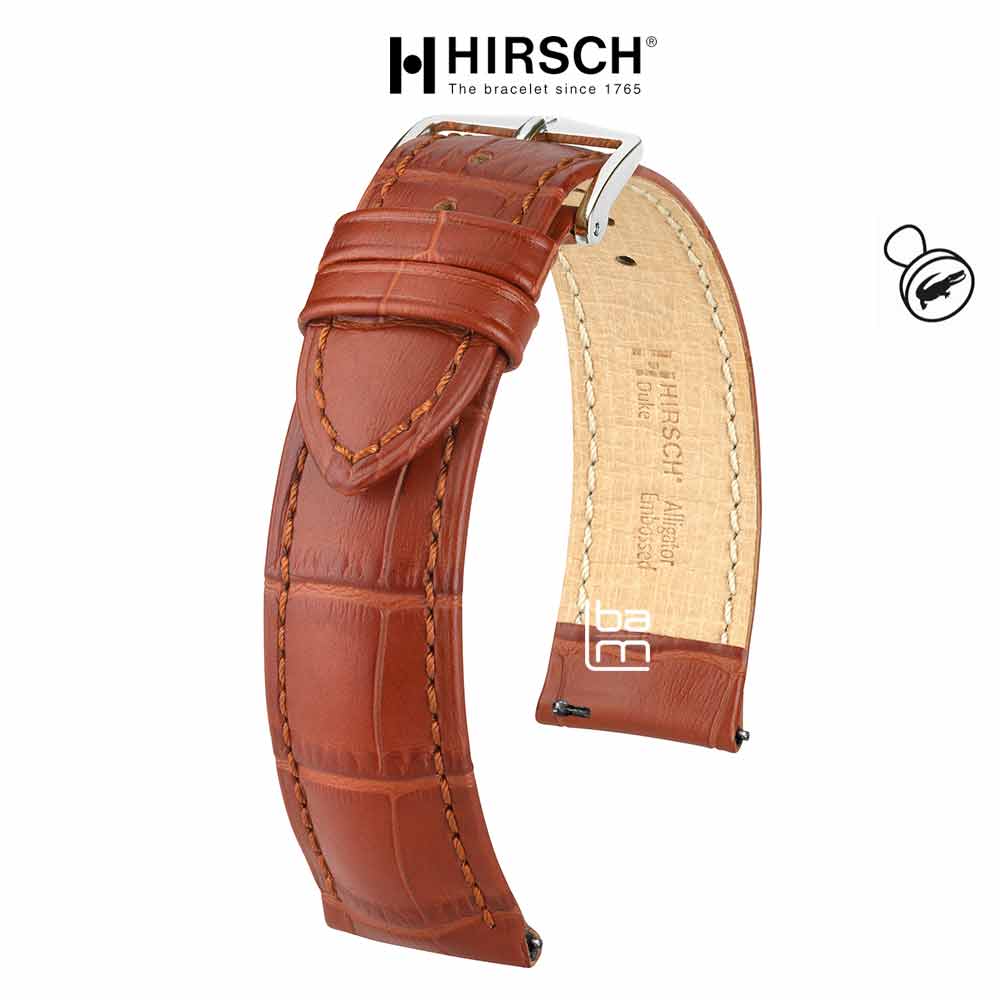
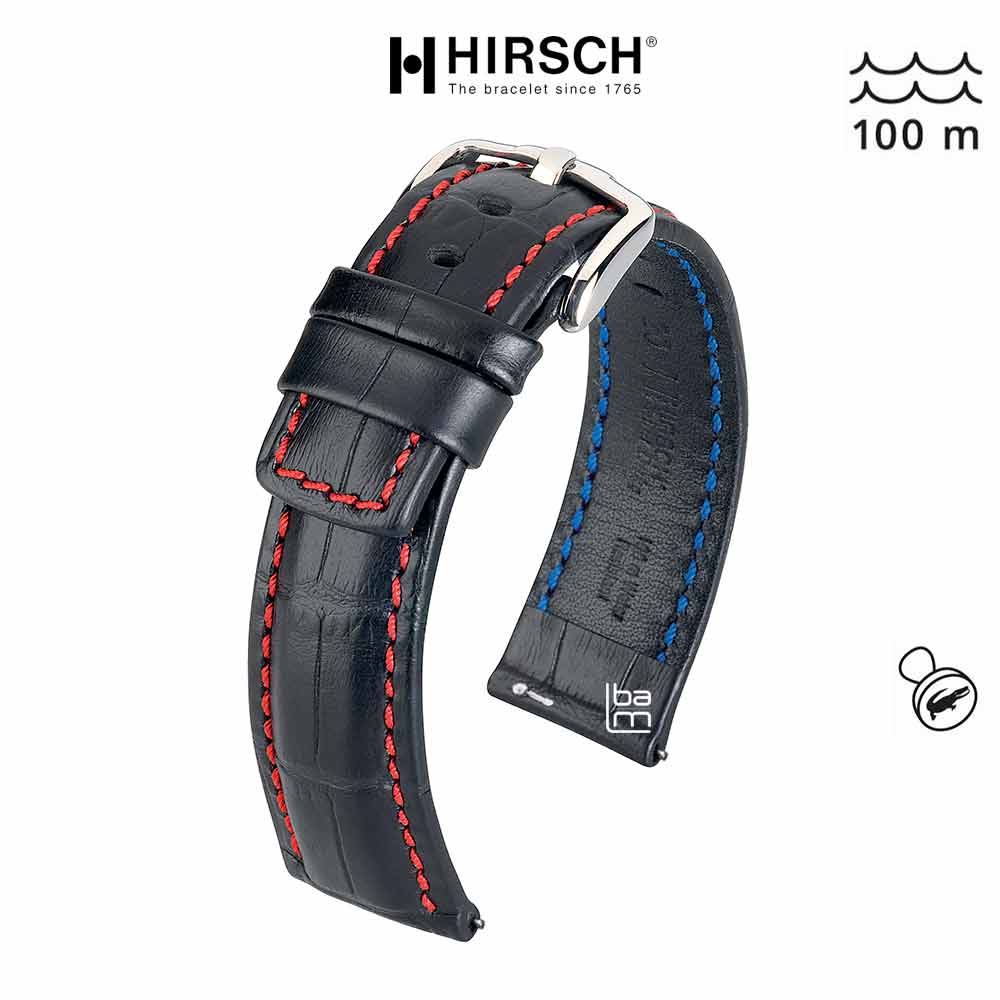
An embossed leather is a calf hide press-stamped with a scale pattern. The imitation of alligator is striking, especially with a coloured patina — and the price remains that of a classic strap. The two flagship models of the Hirsch range: the Duke gold brown and the Grand Duke black waterproof with red stitching, available from 18 to 24 mm.
Genuine precious leathers — ostrich, lizard, crocodile, alligator — are imported under strict CITES control. They are superb, but more fragile than a classic leather.
Knowing how to recognise them protects against counterfeits. A genuine ostrich hide shows only a few raised points on the surface, the quill follicles. Crocodile has slightly rounded scales, alligator has square scales, and alligator flank has perfectly circular ones. Farmed crocodile remains considerably cheaper than Mississippi alligator.
Two examples available in our shop: the Hirsch Capitano Alligator black waterproof and the Arezzo Dark-Croco honey, rubber-lined, both in 20 and 22 mm.

Waterproof leathers and technical ranges
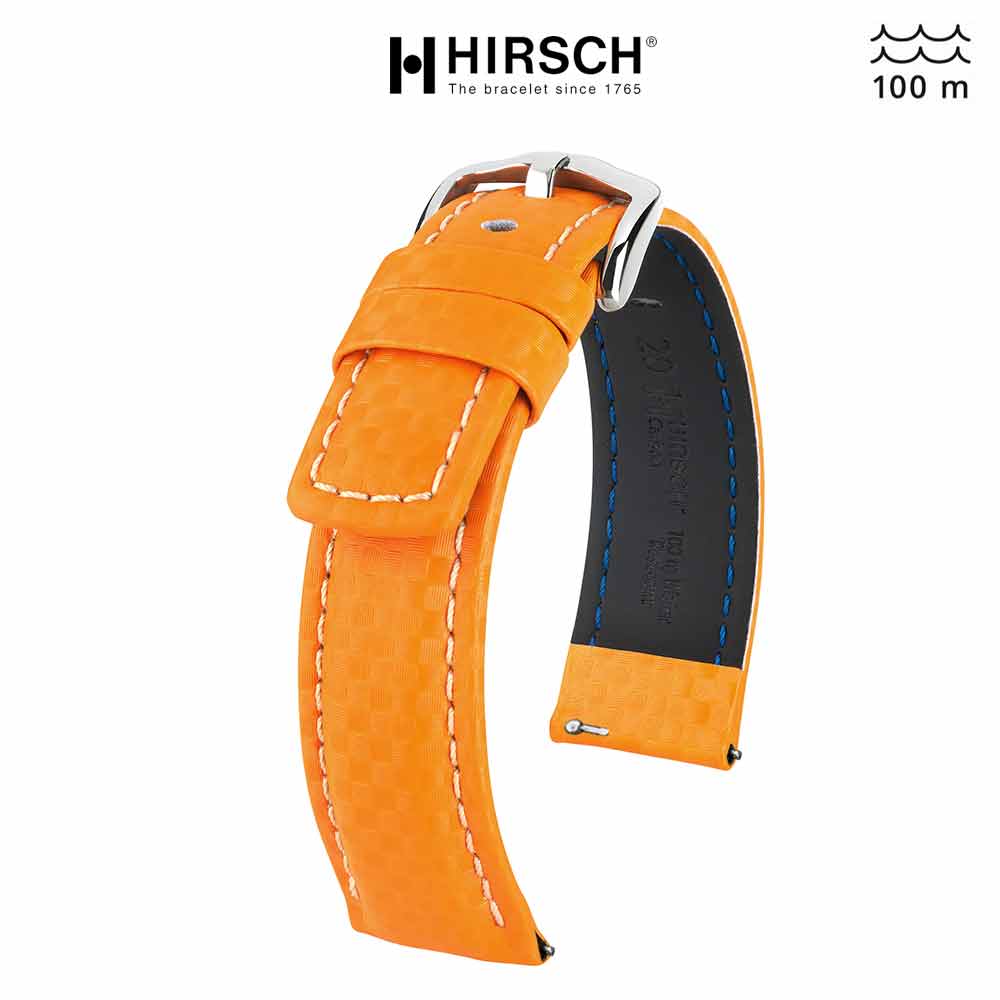
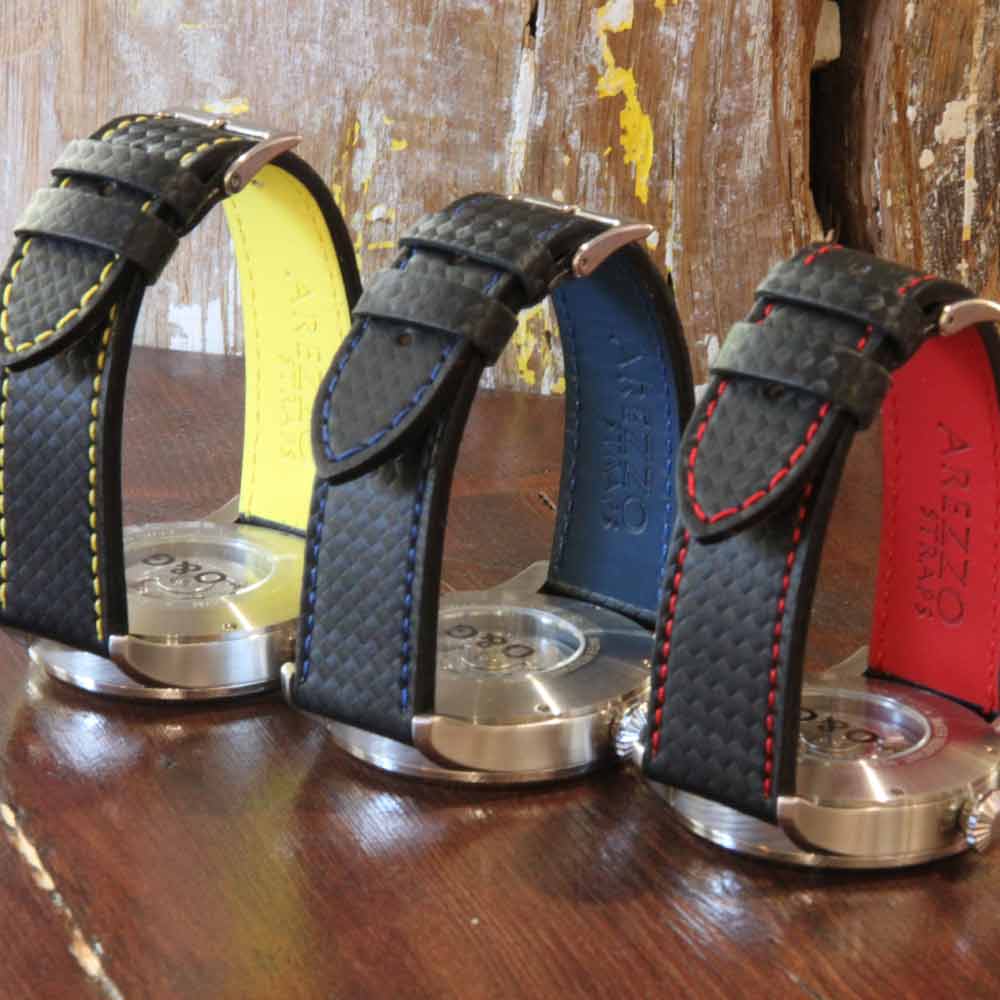
Some leathers undergo an oil-enriched tanning that makes them water-resistant. The most technical versions add a rubber lining and specific bonding to guarantee water resistance. Longer life, sporty look — the surface is often carbon-embossed, as on the Hirsch Carbon orange or the Arezzo Racing.
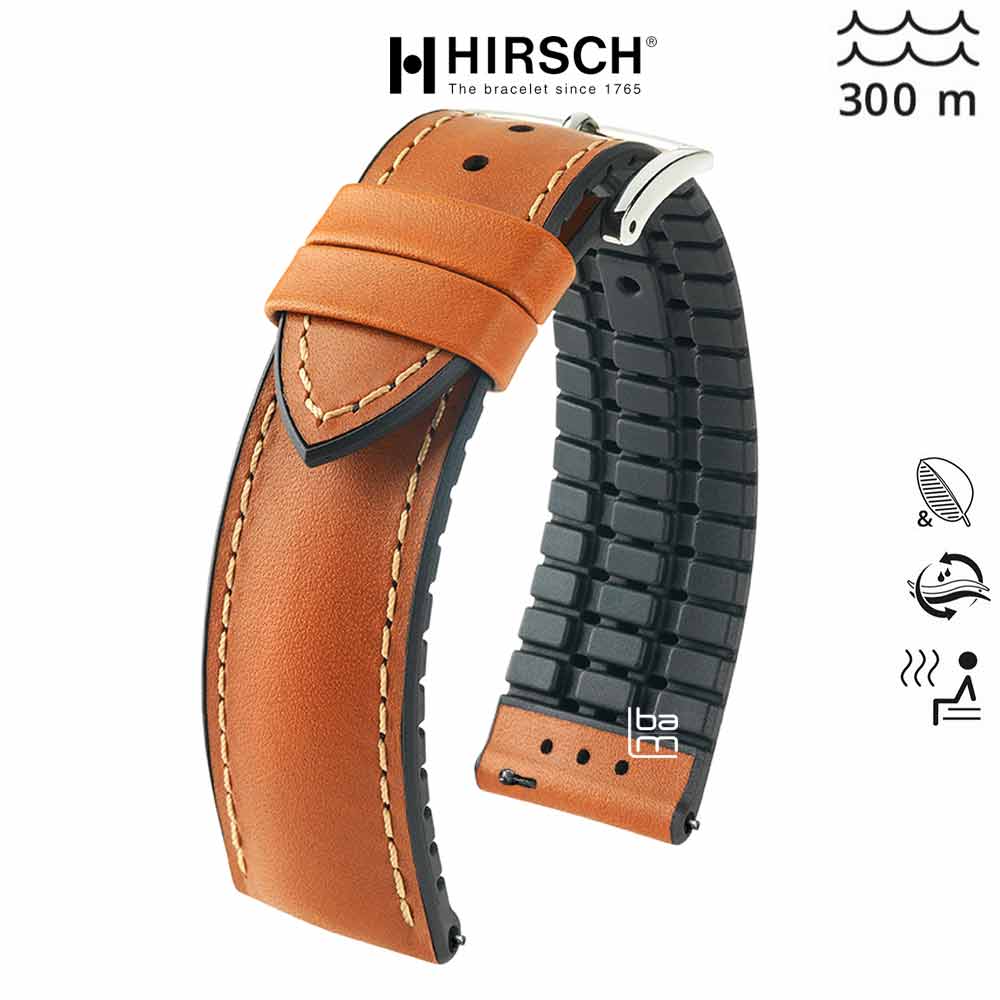
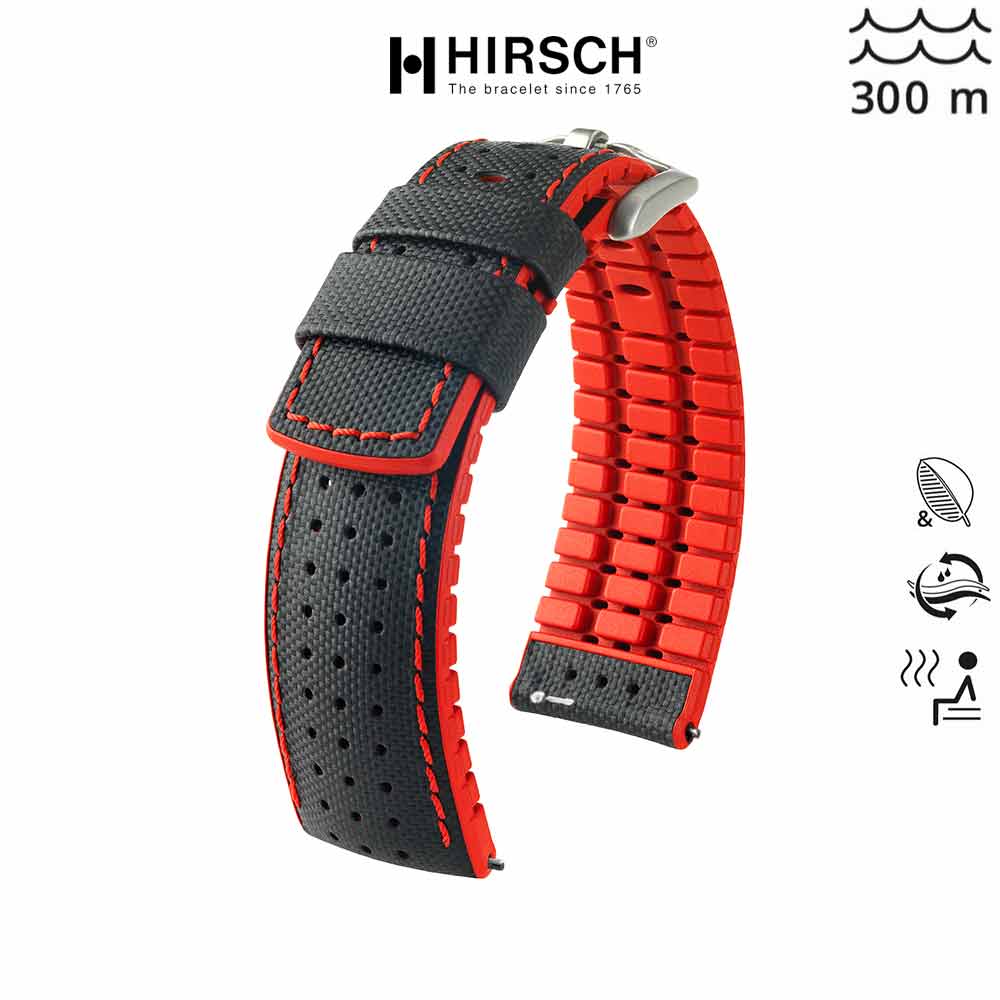
The Hirsch Performance range takes the principle further: a genuine rubber core covered with classic or precious leather, with a patented grid pattern on the rubber section that promotes drying and channels perspiration away. Waterproof, sauna-resistant, water-resistant to 300 m. Two representative references: the Hirsch James gold brown and the Hirsch Robby in red and black.
Beware of imitations: many websites offer a similar look on a silicone base with cheap leather bonded on top. The appearance is there, the engineering is not.
Rubber: natural or synthetic
The distinction is decisive. Rubber belongs to the elastomer family. Natural rubber comes from the latex of the hevea tree; synthetic rubber is derived from hydrocarbons or silicon.
Genuine rubber costs more, but it resists traction and tearing, withstands heat, and feels far more pleasant than polyurethane or silicone. It is manufactured in Europe.
Synthetic appeals through its price and its endless range of colours, but its excessive softness makes it unsuitable for technical use, and it eventually cracks. It is the material of imported elastic straps.
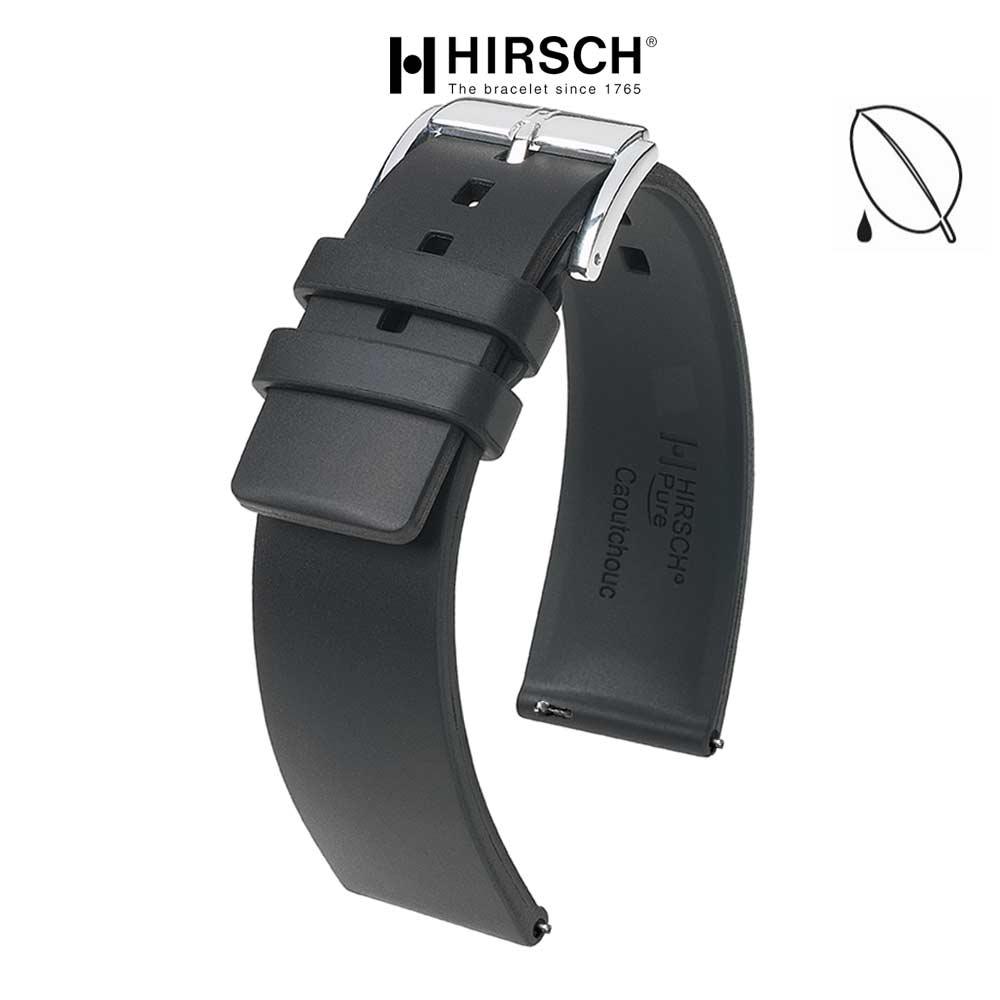
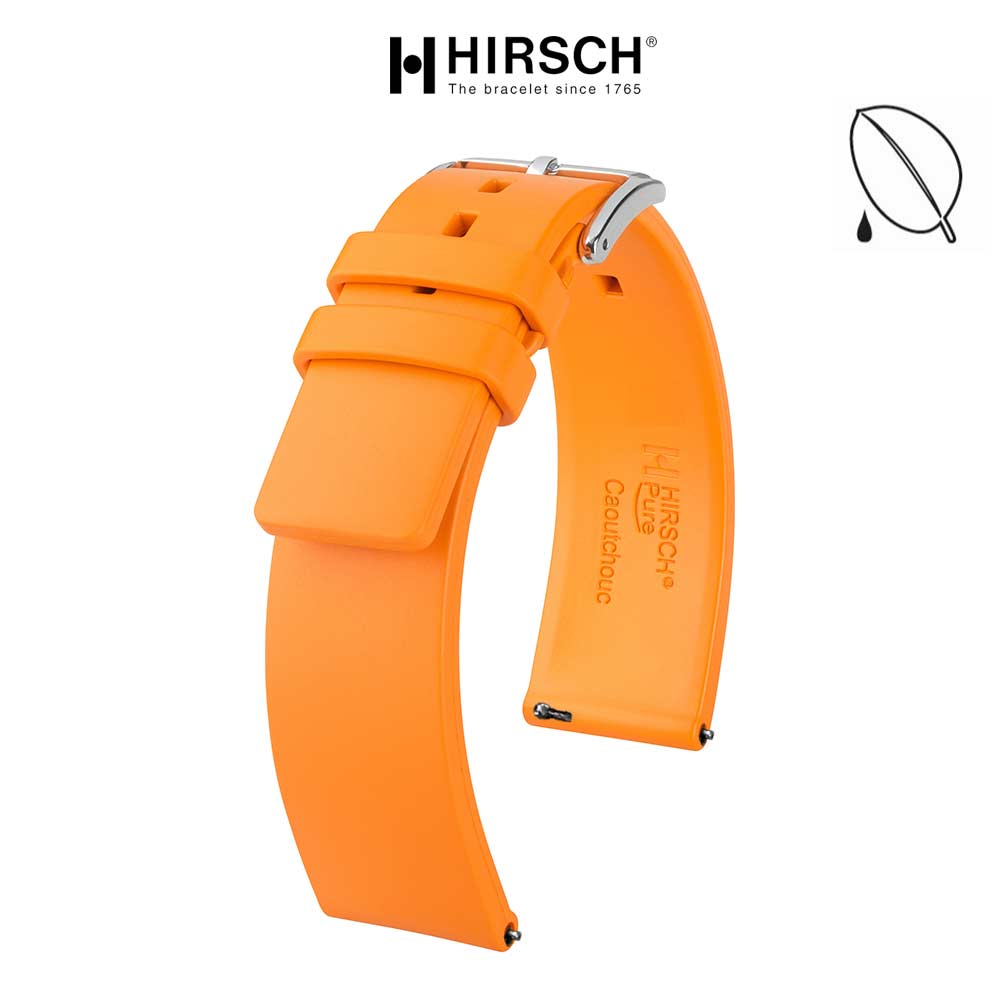
The benchmark in this category remains the Hirsch Pure in black rubber, also available in orange and blue.
NATO and rally straps
The NATO strap is a single piece of woven nylon, passing right under the case. Its safety comes from that: if one spring bar gives way, the watch is still held by the second pass. It changes in fifteen seconds, resists water and can be machine washed.
Its history and uses are covered in our dossier: the history of the NATO strap.
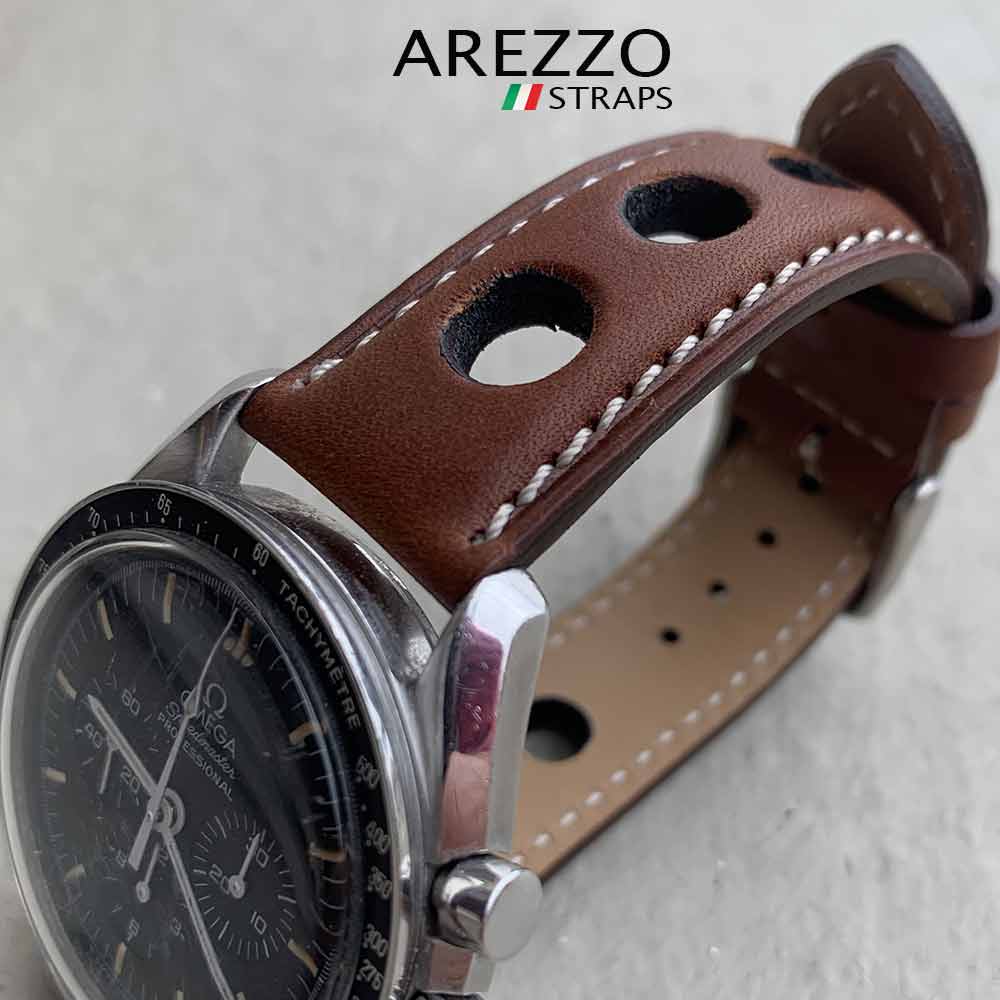
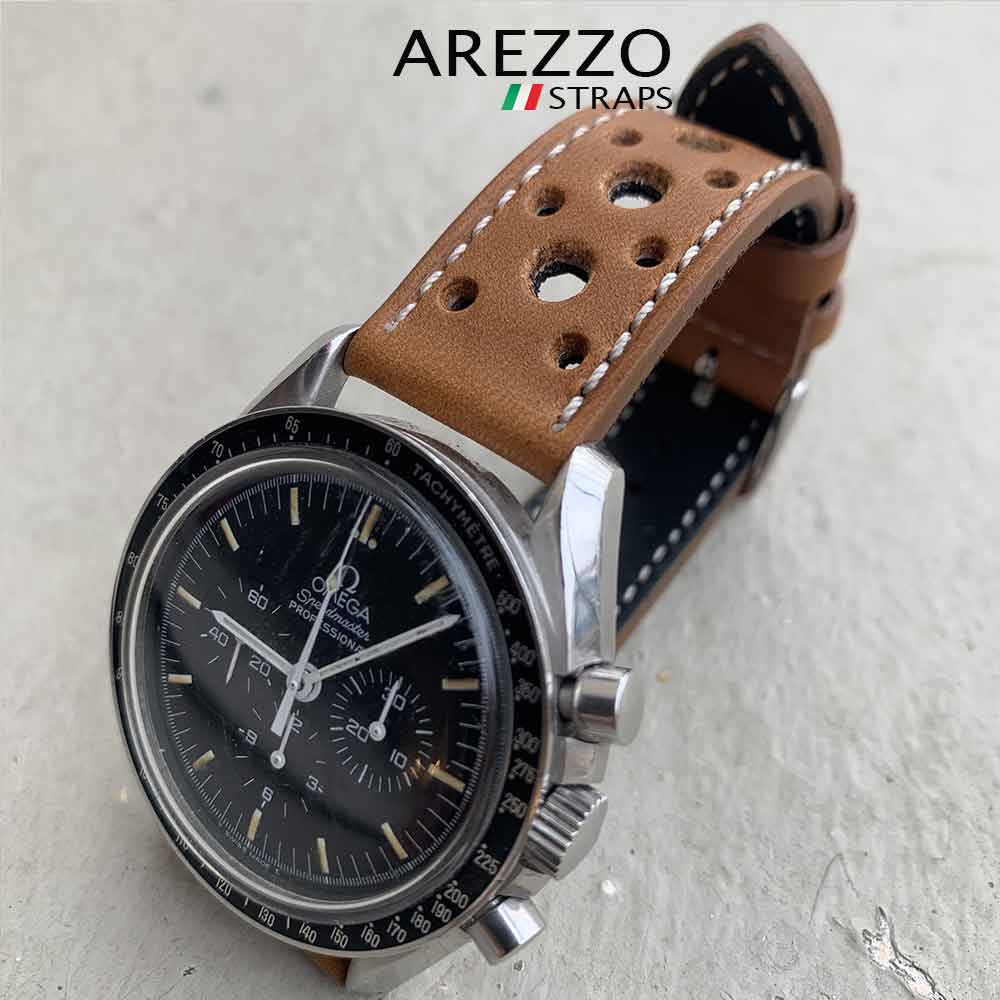
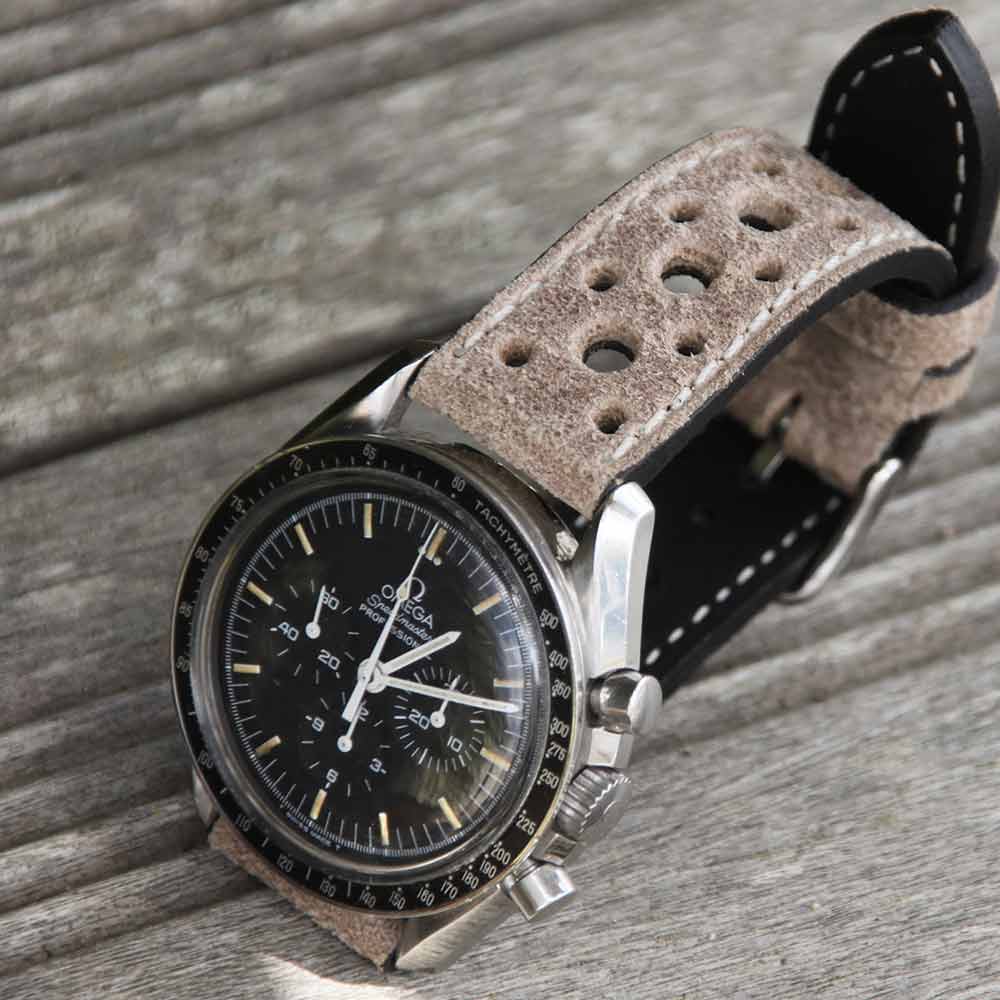
The rally strap, pierced with three holes or more, was designed for chronographs. It lightens the wrist, ventilates, and pairs naturally with a Speedmaster or any three-register watch. Two Arezzo models: the Monza three-hole, the more vintage of the two, and the Maranello multi-hole, in smooth or suede leather.
Matching colours
The same watch changes character entirely depending on its strap — provided the pairing works. Several criteria come into play: the age of the watch, the thickness of the case, the colour of the dial and hands, and your own dress style.
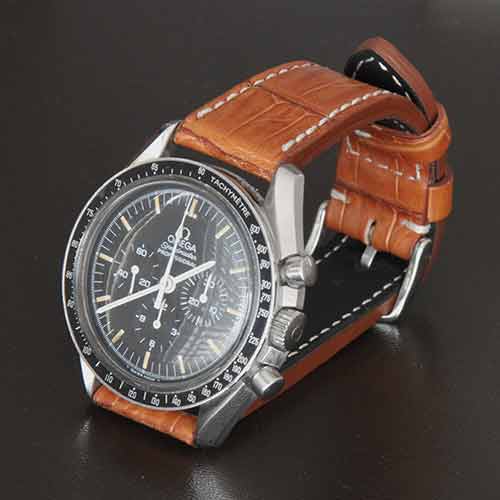
The same Omega Speedmaster, same camera angle, four straps from €19 to €299.
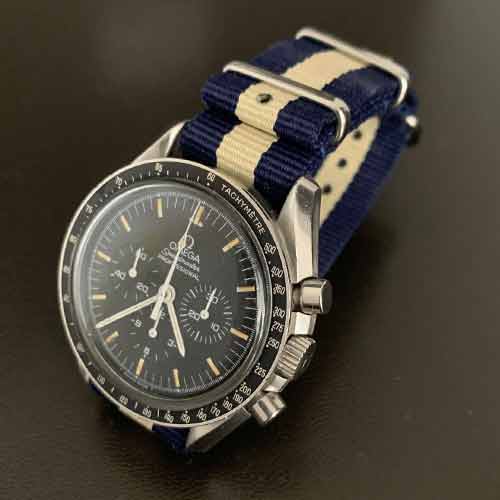
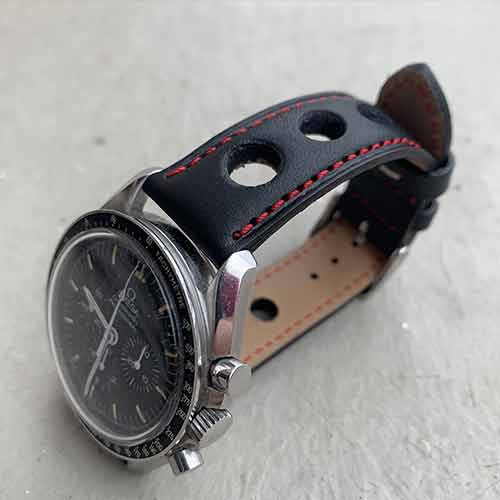
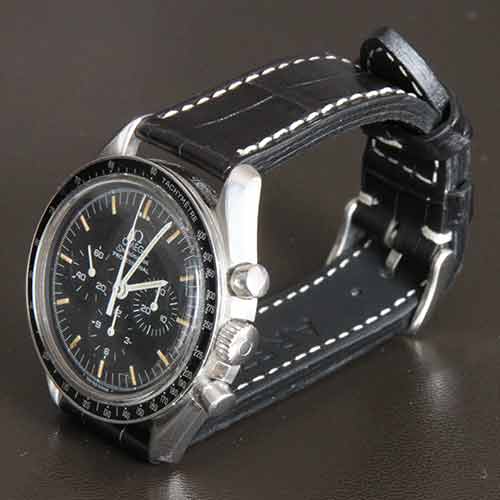
The basic rule is to match the strap to the dial or the hands.
On an older watch, with patinated indices and hands, avoid stitching that is too white: it hardens the whole. Prefer a strap with no visible stitching, or tone-on-tone stitching. Black leather works equally well with a light or dark dial; the same is true of brown and beige. Navy blue, on the other hand, sits poorly with older gold-tone watches.
On a modern watch, indices and hands are bright, steel or painted. Visible stitching can then echo the hands. Red stitching works well provided something on the dial picks it up — an inscription, or at the very least the seconds hand.
Pin buckle or deployant clasp?
Pin buckles
The pin buckle works on the same principle as a belt buckle: the holes in the long section allow precise adjustment. All our straps are fitted with one as standard, generally in silver-tone stainless steel, also available in gold tone.
Pins are slim, suited to small adjustment holes. Some sports straps use wide pins, which require enlarged oval holes — the GPF style found on Panerai or Bell & Ross.
Deployant clasps
Two families exist. The basic V-shaped deployant, single-hinged, clips shut under pressure. The butterfly deployant, in three parts with two hinges, includes a mechanical lock: it opens only when both side buttons are pressed simultaneously.
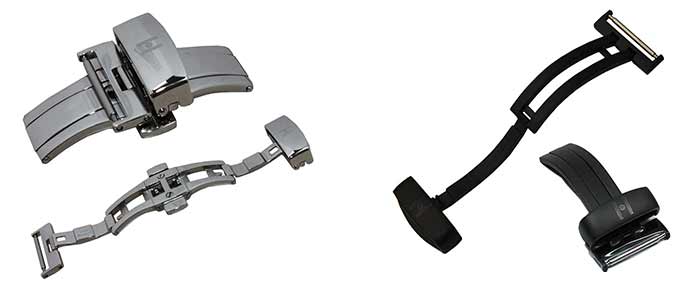
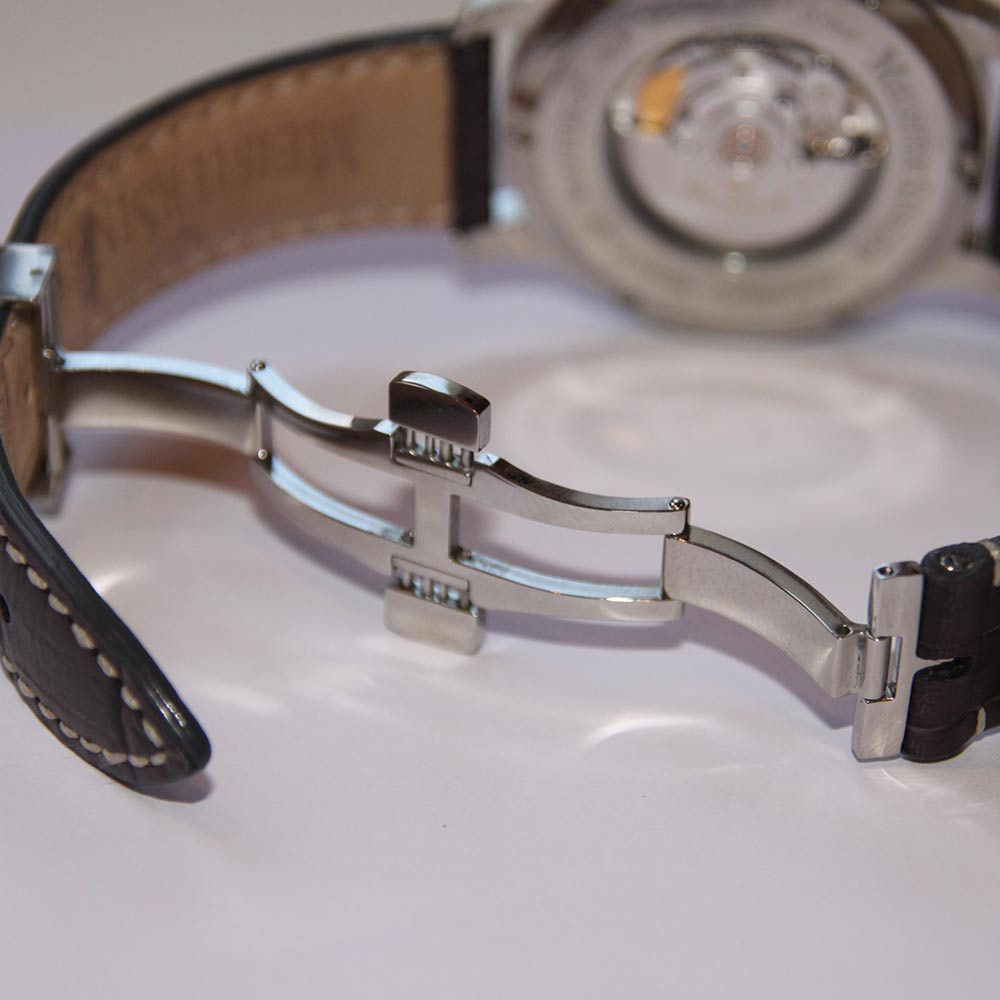
Take care with the original clasps of certain brands. So-called standard deployants use the strap's adjustment holes: the strap therefore remains interchangeable. Others, notably at Breitling, clamp the strap to adjust its length — in which case your new strap will need to be exactly the same thickness.
Fitting a deployant clasp to a standard strap
The operation is simple. Take the example of a 20 mm strap bought from our shop: its exact size is 20/18, meaning 20 mm at the lugs and 18 mm at the buckle. You therefore need an 18 mm deployant clasp to replace the original pin buckle.
Lug width by brand: find the right strap size
The lug width is the gap between the two lugs of your watch, in millimetres. It is this measurement, and not the case diameter, that determines the strap width to choose. Find your watch below; if in doubt, measure the gap between your lugs before ordering.
| Brand | Model | Lug width | Type |
|---|---|---|---|
| A. Lange & Sohne | Lange 1 | 20 mm | Dress |
| Saxonia | 20 mm | Dress | |
| Audemars Piguet | Code 11.59 | 22 mm | Dress |
| Royal Oak | integrated† | Sport | |
| Baume & Mercier | Classima 31 dame | 16 mm | Dress |
| Clifton | 20 mm | Dress | |
| Bell & Ross | BR V2-94 | 22 mm | Sport |
| BR01 | 24 mm | Sport | |
| BR03 | 24 mm | Sport | |
| Blancpain | Fifty Fathoms 42 | 22 mm | Dive |
| Breitling | Premier 40 | 20 mm | Sport |
| Chronomat B01 42 | 22 mm | Sport | |
| Colt | 22 mm | Pilot | |
| Navitimer 41 | 22 mm | Pilot | |
| Navitimer 43 | 22 mm | Pilot | |
| Premier B01 Chronograph 42 | 22 mm | Chronograph | |
| SuperOcean Heritage | 22 mm | Pilot | |
| Top Time | 22 mm | Chronograph | |
| Bremont | Supermarine | 22 mm | Sport |
| CWC | G10 | 18 mm | Field |
| RN Diver | 20 mm | Dive | |
| SBS Diver | 20 mm | Dive | |
| Cartier | Tank Louis Small | 16 mm | Dress |
| Tank Louis | 19 mm | Dress | |
| Tank Must | 19 mm | Dress | |
| Ballon Bleu 40 | 20 mm† | Sport | |
| Ronde | 20 mm | Dress | |
| Santos | integrated† | Sport | |
| Tank Française Small | integrated† | Dress | |
| Certina | DS-1 Small | 20 mm | Dress |
| Chopard | L.U.C | 20 mm | Dress |
| Citizen | Chandler | 18 mm | Field |
| NB1050 | 19 mm | Sport | |
| Fujitsubo | 20 mm | Dive | |
| Promaster Diver | 20 mm | Dive | |
| Promaster Eco-Drive | 22 mm | Dive | |
| Aqualand | 24 mm | Dive | |
| Promaster 1000 m | 29 mm† | Dive | |
| Diesel | DZ1649 | 26 mm | Sport |
| DZ1766 | 24 mm | Sport | |
| DZ4192 | 26 mm | Sport | |
| DZ4238 | 24 mm | Sport | |
| DZ4280 | 26 mm | Sport | |
| DZ4374 | 24 mm | Sport | |
| DZ7258 Little Daddy | 24 mm | Sport | |
| DZ7259 | 24 mm | Sport | |
| DZ7416 | 26 mm | Sport | |
| DZ7426 | 26 mm | Sport | |
| DZ7474 | 24 mm | Sport | |
| Doxa | Sub 200 | 20 mm | Dive |
| Sub 300 | 20 mm | Dive | |
| Fortis | B42 | 20 mm | Pilot |
| Frederique Constant | Slimline Dame | 16 mm | Dress |
| Slimline 37 | 18 mm | Dress | |
| Classics | 20 mm | Dress | |
| Slimline | 20 mm | Dress | |
| Glashutte Original | Senator | 20 mm | Dress |
| Grand Seiko | Elegance | 19 mm | Sport |
| SBGW231 | 19 mm | Sport | |
| SBGA211 Snowflake | 22 mm | Sport | |
| Spring Drive Chronograph | 23 mm | Chronograph | |
| Hamilton | American Classic Boulton | 18 mm | Dress |
| Intra-Matic 34 | 18 mm | Dress | |
| Khaki Pilot Pioneer | 18 mm | Pilot | |
| Intra-Matic | 19 mm | Dress | |
| Jazzmaster | 20 mm | Dress | |
| Khaki Aviation | 20 mm | Pilot | |
| Khaki Field Auto | 20 mm | Field | |
| Khaki Field Mechanical 38 | 20 mm | Field | |
| Jazzmaster Auto Chrono | 22 mm | Chronograph | |
| Khaki Aviation Converter | 22 mm | Pilot | |
| Khaki Navy Frogman | 22 mm | Dive | |
| Invicta | Pro Diver (24 mm series) | 24 mm | Dive |
| Reserve Venom 1401, 6105, 6112, 6118, 6588 | 26 mm | Dive | |
| Subaqua Noma IV 6564, 6584 to 6586, 16145 | 26 mm | Dive | |
| Subaqua Noma Reverse 6212 | 26 mm | Dive | |
| Subaqua Noma V 12880 to 12888 | 26 mm | Dive | |
| IWC | Mark XVIII | 20 mm | Pilot |
| Mark XX | 20 mm | Pilot | |
| Pilot Mark XVIII | 20 mm | Pilot | |
| Portofino 40 | 20 mm | Dress | |
| Portugieser 40.4 | 20 mm | Pilot | |
| Portugieser Chronograph | 20 mm | Pilot | |
| Big Pilot 43 | 21 mm | Pilot | |
| Big Pilot 46 | 22 mm | Pilot | |
| Portugieser 42 | 22 mm | Pilot | |
| Ingenieur (2023) | integrated† | Sport | |
| Jaeger-LeCoultre | Master Compressor Extreme World Chrono | 26 mm | Chronograph |
| Master Control | 21 mm | Dress | |
| Master Ultra Thin | 21 mm | Dress | |
| Reverso | 20 mm | Dress | |
| Junghans | Max Bill Handaufzug 34 | 18 mm | Dress |
| Max Bill | 20 mm | Dress | |
| Longines | Conquest Heritage 35 | 18 mm | Dress |
| DolceVita dame | 18 mm† | Dress | |
| Flagship Heritage | 19 mm | Dress | |
| Heritage Classic | 19 mm | Dress | |
| HydroConquest 39 | 19 mm | Sport | |
| Presence | 19 mm | Dress | |
| Présence 38.5 | 19 mm | Dress | |
| Spirit 37 | 19 mm | Sport | |
| Avigation BigEye | 20 mm | Pilot | |
| DolceVita | 20 mm | Dress | |
| Legend Diver 39 | 20 mm | Dive | |
| Master Collection | 20 mm | Dress | |
| Master Chronograph | 21 mm | Chronograph | |
| Spirit 40 | 21 mm | Sport | |
| Spirit Zulu Time 39 | 21 mm | Sport | |
| La Grande Classique | integrated† | Sport | |
| Luminox | Navy SEAL | 23 mm | Dive |
| Marathon | General Purpose | 16 mm | Field |
| GSAR | 20 mm | Dive | |
| TSAR | 20 mm | Dive | |
| JSAR | 22 mm | Dive | |
| Jumbo Diver | 22 mm | Dive | |
| Mido | Baroncelli III | 20 mm | Dress |
| Montblanc | 1858 Automatic | 20 mm | Dress |
| Heritage | 20 mm | Dress | |
| 1858 Geosphere | 22 mm | Dress | |
| Nomos | Ludwig 33 | 17 mm | Sport |
| Orion 35 | 18 mm | Dress | |
| Tangente 35 | 18 mm | Dress | |
| Orion | 19 mm | Dress | |
| Club | 20 mm | Dress | |
| Tangente 38 | 20 mm | Dress | |
| Omega | 30t2 | 18 mm | Sport |
| De Ville vintage | 18 mm | Dress | |
| Genève vintage | 18 mm | Sport | |
| Seamaster Vintage 34 | 18 mm | Dive | |
| Constellation | 19 mm† | Sport | |
| De Ville Prestige | 19 mm | Dress | |
| Seamaster Aqua Terra 38 | 19 mm | Dive | |
| Aqua Terra 38 | 20 mm | Sport | |
| Aqua Terra 41 | 20 mm | Sport | |
| De Ville Tresor | 20 mm | Dress | |
| Globemaster | 20 mm | Dress | |
| Railmaster 40 | 20 mm | Sport | |
| Seamaster 300 Heritage | 20 mm | Dive | |
| Seamaster Aqua Terra 41 | 20 mm | Dive | |
| Seamaster Diver 300M | 20 mm | Dive | |
| Speedmaster Professional Moonwatch | 20 mm | Chronograph | |
| Planet Ocean 42 | 21 mm | Sport | |
| Planet Ocean XL | 22 mm | Sport | |
| Oris | Artelier Date 34 | 16 mm | Dress |
| Big Crown Pointer Date | 20 mm | Sport | |
| Big Crown ProPilot 41 | 20 mm | Pilot | |
| Artelier | 21 mm | Dress | |
| Aquis 43 | 24 mm† | Dive | |
| ProDiver | 26 mm | Dive | |
| Panerai | Egiziano | 26 mm | Sport |
| Luminor 1950 8 Days | 26 mm | Sport | |
| Luminor Due 42 | 22 mm | Sport | |
| Luminor Marina 42 | 22 mm | Sport | |
| Luminor Marina 44 | 24 mm | Sport | |
| Luminor Submersible 1950 47 (PAM569) | 26 mm | Dive | |
| PAM000 | 24 mm | Sport | |
| PAM005 | 24 mm | Sport | |
| PAM021 | 26 mm | Sport | |
| PAM111 | 24 mm | Sport | |
| PAM112 | 24 mm | Sport | |
| PAM176 | 24 mm | Sport | |
| PAM177 | 24 mm | Sport | |
| PAM305 | 26 mm | Sport | |
| PAM312 | 24 mm | Sport | |
| PAM320 | 24 mm | Sport | |
| PAM372 | 26 mm | Sport | |
| PAM389 | 26 mm | Sport | |
| PAM392 | 24 mm | Sport | |
| PAM422 | 26 mm | Sport | |
| PAM423 | 26 mm | Sport | |
| PAM424 | 26 mm | Sport | |
| PAM507 | 26 mm | Sport | |
| Radiomir 8 Days | 26 mm | Sport | |
| Radiomir 10 Days GMT (PAM323) | 26 mm | Sport | |
| Radiomir 45 | 24 mm | Sport | |
| Radiomir 47 | 26 mm | Sport | |
| Radiomir 1940 (45 and 47) | 26 mm | Sport | |
| Radiomir Black Seal (PAM183 to PAM388) | 26 mm | Sport | |
| Submersible 44 | 24 mm | Dive | |
| Submersible Brabus (PAM1241) | 26 mm | Dive | |
| Submersible Chrono Flyback (PAM1020) | 26 mm | Chronograph | |
| Submersible Depth Gauge (PAM193) | 26 mm | Dive | |
| Patek Philippe | Calatrava | 20 mm | Dress |
| Aquanaut | integrated† | Sport | |
| Nautilus | integrated† | Sport | |
| Piaget | Altiplano | 21 mm | Dress |
| Rado | Coupole dame | integrated† | Sport |
| Raymond Weil | Toccata | 20 mm | Dress |
| Rolex | Lady-Datejust 28 | 13 mm† | Dress |
| Datejust 31 | 14 mm | Dress | |
| Air-King 5500 | 19 mm | Sport | |
| Date 1500 | 19 mm | Sport | |
| Oyster Perpetual 34 | 19 mm | Dress | |
| 1908 39 | 20 mm | Dress | |
| Air-King 126900 | 20 mm | Sport | |
| Cellini | 20 mm | Dress | |
| Datejust 36 | 20 mm | Dress | |
| Day-Date 36 | 20 mm | Dress | |
| Day-Date 40 | 20 mm | Dress | |
| Daytona 40 | 20 mm | Chronograph | |
| Explorer 114270 | 20 mm | Field | |
| Explorer 14270 | 20 mm | Field | |
| Explorer 36 | 20 mm | Field | |
| Explorer II | 20 mm | Field | |
| GMT-Master 1675 | 20 mm | Sport | |
| GMT-Master II | 20 mm | Sport | |
| Milgauss | 20 mm | Sport | |
| Oyster Perpetual 36 | 20 mm | Dress | |
| Sea-Dweller 16600 | 20 mm | Dive | |
| Submariner 14060 | 20 mm | Dive | |
| Submariner 16610 | 20 mm | Dive | |
| Submariner 5513 | 20 mm | Dive | |
| Yacht-Master 40 | 20 mm | Sport | |
| Datejust 41 | 21 mm | Dress | |
| Deepsea Sea-Dweller | 22 mm | Dive | |
| Deepsea Challenge | 23 mm | Dive | |
| Seiko | SNK809 | 18 mm | Field |
| SNXS79 | 18 mm | Field | |
| Alpinist | 20 mm | Sport | |
| Monster | 20 mm | Dive | |
| Presage Cocktail SRPB43 | 20 mm | Dress | |
| SPB143 | 20 mm | Sport | |
| SPB147 | 20 mm | Sport | |
| SPB151 | 20 mm | Sport | |
| SPB153 | 20 mm | Sport | |
| Sumo | 20 mm | Sport | |
| Arnie | 22 mm | Sport | |
| SKX007 | 22 mm | Dive | |
| SKX009 | 22 mm | Dive | |
| Samurai | 22 mm | Dive | |
| Tuna Professional | 22 mm | Dive | |
| Turtle King | 22 mm | Dive | |
| Sinn | 104 | 20 mm | Sport |
| 556 | 20 mm | Sport | |
| 856 | 20 mm | Sport | |
| 857 | 22 mm | Sport | |
| U1 | 22 mm | Dive | |
| U2 | 22 mm | Dive | |
| Squale | 1521 | 20 mm | Dive |
| TAG Heuer | Carrera 42 | 20 mm | Chronograph |
| Monaco | 22 mm | Chronograph | |
| Timex | Expedition Scout | 20 mm | Field |
| Tissot | PRX 35 | integrated† | Sport |
| Le Locle 25 dame | 14 mm | Dress | |
| Bellissima | 16 mm | Dress | |
| Everytime Small | 16 mm | Dress | |
| Le Locle | 19 mm | Dress | |
| Carson | 20 mm | Dress | |
| Visodate | 20 mm | Dress | |
| Gentleman | 21 mm | Sport | |
| Tudor | 1926 28 | 15 mm | Dress |
| 1926 36 | 19 mm | Dress | |
| Prince Date 34 | 19 mm | Sport | |
| Black Bay 54 | 20 mm | Dive | |
| Black Bay 58 | 20 mm | Dive | |
| Glamour Date | 20 mm | Dress | |
| Ranger | 20 mm | Field | |
| 1926 39 | 21 mm | Dress | |
| Pelagos 39 | 21 mm | Dive | |
| 1926 41 | 22 mm | Dress | |
| Black Bay Chrono | 22 mm | Dive | |
| Black Bay Pro | 22 mm | Dive | |
| Pelagos 42 | 22 mm | Dive | |
| Royal | 22 mm† | Sport | |
| U-Boat | Classico | 22 mm | Sport |
| Vacheron Constantin | Patrimony | 20 mm | Dress |
| Traditionnelle | 20 mm | Dress | |
| Overseas | integrated† | Sport | |
| Zenith | Chronomaster Original | 19 mm | Sport |
| Elite | 20 mm | Dress | |
| Pilot Type 20 | 22 mm | Pilot | |
| Defy Skyline | integrated† | Sport |
† Watch with an integrated bracelet or proprietary fitting: a standard spring-bar strap will not fit directly, a specific strap is required.
Indicative list of 272 references. The same watch may exist in several case sizes with different lug widths — check yours if in doubt.
FAQ — Watch strap size and dimensions
How do I measure the size of a watch strap?
Measure the lug width, that is the gap between the two lugs of the case, with a vernier caliper or a ruler. This measurement in millimetres corresponds directly to the strap width to order. Do not measure your old strap, which may be deformed or wrongly sized.
What is the difference between lug width and strap width?
None: they are two ways of naming the same measurement. Lug width refers to the gap between the lugs on the watch side; strap width is that of its attachment end. The two must be identical.
What strap length suits my wrist size?
A standard 20 cm strap suits wrists from 16 to 20 cm. Below that, choose a Medium length at 18 cm. Above, or for wearing over clothing, choose an XL length at 22 cm.
My lug width is 21 mm: what can I fit?
Straps in 19 and 21 mm exist but remain uncommon. On a 21 mm lug width, a 20 mm strap fits with a visible gap; a 22 mm one will not go in. Avoid Quick Release straps, however, as they require an exact size.
How do I know whether my watch takes a standard strap?
Look between the lugs: if you can see a removable spring bar, your watch takes a standard strap. Watches with an integrated bracelet or a proprietary fitting — Royal Oak, Nautilus, Overseas, certain PRX models — require a strap specific to the brand.
What spring bar size for a 20 mm lug width?
20 mm spring bars: the length of the bar always matches the lug width. For the diameter, choose 1.8 mm stainless steel rather than the standard 1.5 mm, particularly on a NATO strap.
Our watch strap collections
NATO straps NATO 18mm NATO 20mm NATO 22mm NATO 24mm Marine Nationale
HIRSCH straps HIRSCH 20mm AREZZO straps Rubber straps
Stainless steel spring bars Buckles and deployant clasps Bergeon 6767F tool
Going further:
Removing a watch strap — video guide
How to fit a NATO strap
The history of the NATO strap
Questions about watch winders for automatic watches? Read our complete guide:
Feel free to contact us by telephone on +33 9 80 84 88 08.
Follow La Boîte à Montres on social media:

