


Watch winder for automatic watches — how to choose the right one
Since 2010, La Boîte à Montres has been advising collectors and watch enthusiasts on the choice of their accessories. This complete guide explains everything about watch winders for automatic watches: why you need one, how to choose the right winding programme, and which brands set the standard — Swiss Kubik, Rapport London and Scatola del Tempo above all.
Why use a watch winder for an automatic watch?
How does an automatic watch work?
Which winding programme for your timepiece?
Safe, battery or mains: what are the constraints?
Which brands are approved by the great watchmaking houses?
Which watch winder should you choose?
Swiss Kubik: the Swiss reference approved by Rolex
Rapport London EVO MK3: the best value for money
Scatola del Tempo: the Italian case with Swiss technology
How to use a watch winder: the 4 steps
A brief history of the watch winder
FAQ — Watch winder for automatic watches
Our selection of watch winders
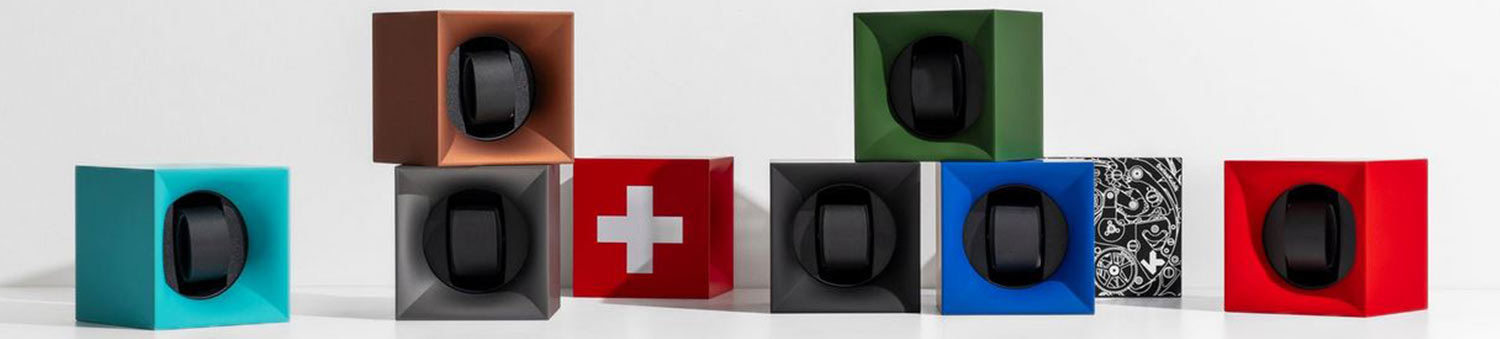
Why use a watch winder for an automatic watch?
An automatic watch that is not worn stops within 1 to 3 days, depending on its power reserve. This is not merely an inconvenience: it is also a risk for the movement.
When your timepiece remains still, the watch oils gradually settle and thicken. Over time, the mechanism can seize. Moving parts lose their optimal lubrication. Accuracy deteriorates. And resetting a watch with complications — perpetual calendar, moon phases, GMT — can prove tedious, and even risky for the crown gaskets.
A watch winder for automatic watches solves all of this. By reproducing the natural movements of the wrist, it keeps the oscillating weight active, ensures continuous lubrication of the movement and preserves the accuracy of your timepiece — whether it is a Rolex Submariner, an Omega Seamaster or a Patek Philippe Grand Complications.
How does an automatic watch work?
An automatic watch — or self-winding watch — harnesses the kinetic energy produced by the movements of the wrist. With every gesture, an oscillating weight (the rotor) pivots and winds the mainspring, which stores the energy the movement needs to run.
The balance wheel, the central component of the calibre, controls how this energy is distributed to the gear train and guarantees the accuracy of the watch. As long as the mainspring remains under tension, the balance wheel oscillates and the watch runs. As soon as the energy is exhausted, everything stops.
This is why an automatic watch worn daily keeps time without any intervention. And it is why a watch winder becomes essential as soon as you own several timepieces that you wear in rotation.
Worth noting: a watch worn on the wrist can turn its rotor more than 10,000 times a day. A quality watch winder reproduces a fraction of that movement — enough to keep your watch in perfect condition.
Which winding programme for your timepiece?
The vast majority of automatic watches require between 1,000 and 1,900 rotations per day to run correctly. This figure varies according to the calibre, its age and its complications.
The standard programme: 1,600 turns per day
This is the reference programme. It corresponds to 800 rotations clockwise and 800 anticlockwise, spread over 24 hours. This level of rotation suits almost every watch on the market — Rolex Submariner, Daytona, Air King, Omega, IWC, Breitling, TAG Heuer.
It is the programme installed by default on Swiss Kubik watch winders — approved by Rolex — and adopted by most quality winder manufacturers.
Rest phases: a decisive criterion
Between each rotation sequence, a quality watch winder pauses. During this pause, the mainspring relaxes naturally. This alternation between rotation and rest maintains a constant, intermediate tension in the movement — without over-winding, without premature wear.
Entry-level winders (under €100, Asian manufacture) often run continuously. This forces the watch to remain wound at 100% for hours on end, placing needless strain on the mechanism and potentially affecting the accuracy of your watch over time.
All our watch winders include these rest phases. It is a non-negotiable criterion in our selection.
Stopping in the vertical position
Swiss Kubik, Scatola del Tempo and Rapport London watch winders systematically come to rest in the vertical 12 o'clock position between cycles. This position — known as the resting position — is the optimal one for preserving the regulation of the balance wheel over the long term.
Programmable watch winders
Some older or specific calibres require unidirectional winding only (clockwise or anticlockwise). Others require a precise number of daily turns. In these cases, a programmable watch winder is essential.
The Swiss Kubik Masterbox lets you set the exact number of turns and the direction of rotation via Bluetooth from your smartphone. It therefore adapts to the requirements of 100% of the automatic watches on the market — from the simplest to the most complex.
Safe, battery or mains: what are the constraints for your watch winder?
A watch winder in a safe
If your watch winder is to run inside a safe, the choice is straightforward: it must run on batteries, with enough autonomy to spare you from opening the safe regularly.
Swiss Kubik and Scatola del Tempo offer the highest autonomy on the market: 2 to 3 years with 2 Duracell Procell LR14 batteries. This is unmatched. Other brands generally prioritise a mains connection — convenient day to day, but incompatible with use inside a safe.
The Swiss Kubik Masterbox goes further: it automatically detects the power source and switches from mains to batteries without interrupting the winding programme. As soon as you unplug it, it carries on — with no action required on your part.
Recommendation: use standard alkaline batteries only (Duracell, Energizer). Avoid rechargeable batteries — their variable voltage can disturb the motor.
A watch winder on display in your home
If your watch winder sits on your desk, your bedside table or in your dressing room, the finish becomes as important a criterion as performance. Leather-covered? Anodised aluminium? Piano lacquer? The price rises logically with the quality of the materials.
Swiss Kubik offers a range of Masterbox models in anodised aluminium (anodising treatment for lasting resistance) or covered in genuine leather. Rapport London finishes its EVO MK3 in multi-layer piano lacquer, assembled by hand. Two different approaches, two complementary aesthetic worlds.
Which watch winder brands are approved by the great watchmaking houses?
This is the single most reliable selection criterion. A brand approved by Rolex, Patek Philippe or another great watchmaking house has demonstrated that its winders meet the winding requirements of their most precious calibres.
Swiss Kubik is the first brand to have been officially approved by Rolex. The Geneva-based manufacture has designed bespoke winders for certain watches in the Rolex range. It is an absolute benchmark.
Scatola del Tempo (acquired by Swiss Kubik in 2019) has enjoyed recognition from Patek Philippe for many years — with Swiss Made Swiss Kubik motorisation.
Rapport London — founded in 1898, now in its fourth family generation — is recognised for the quality of its mechanisms and the precision of its 9 rotation programmes, including the settings recommended by Rolex and Omega.
Conversely, be wary of watch winders under €100 sold on Asian websites or in mass retail. Belt-driven motors (a wear part), risk of magnetisation, excessive battery consumption, uncertain lifespan of the electronic boards: the risks for your timepieces are real.
Every watch winder offered by La Boîte à Montres is CE certified and selected for its reliability, its quiet operation and its compatibility with 100% of automatic watches.
Which watch winder should you choose for your automatic watch?
A few questions to guide your choice:
Does your watch have specific rotation requirements?
For the vast majority of watches (Rolex, Omega, IWC, Breitling, TAG Heuer), the standard bidirectional programme of 1,600 turns per day is perfectly suitable. A Swiss Kubik StartBox or a Rapport London EVO MK3 will meet this need.
For a Patek Philippe, a self-winding pocket watch, or any calibre with specific requirements, choose a programmable Swiss Kubik Masterbox.
Will your watch winder be kept in a safe?
Swiss Kubik StartBox or Masterbox — 2 to 3 years of battery autonomy. Rapport London EVO MK3 — more than 18 months of autonomy. These are the only genuinely suitable choices for use inside a safe.
Is it a premium gift?
The leather-covered Swiss Kubik Masterbox and the coloured aluminium finishes are exceptional objects. As for Rapport London, every colour of the EVO MK3 — including Rolex Racing Green — is assembled by hand.
Swiss Kubik: the Swiss reference approved by Rolex
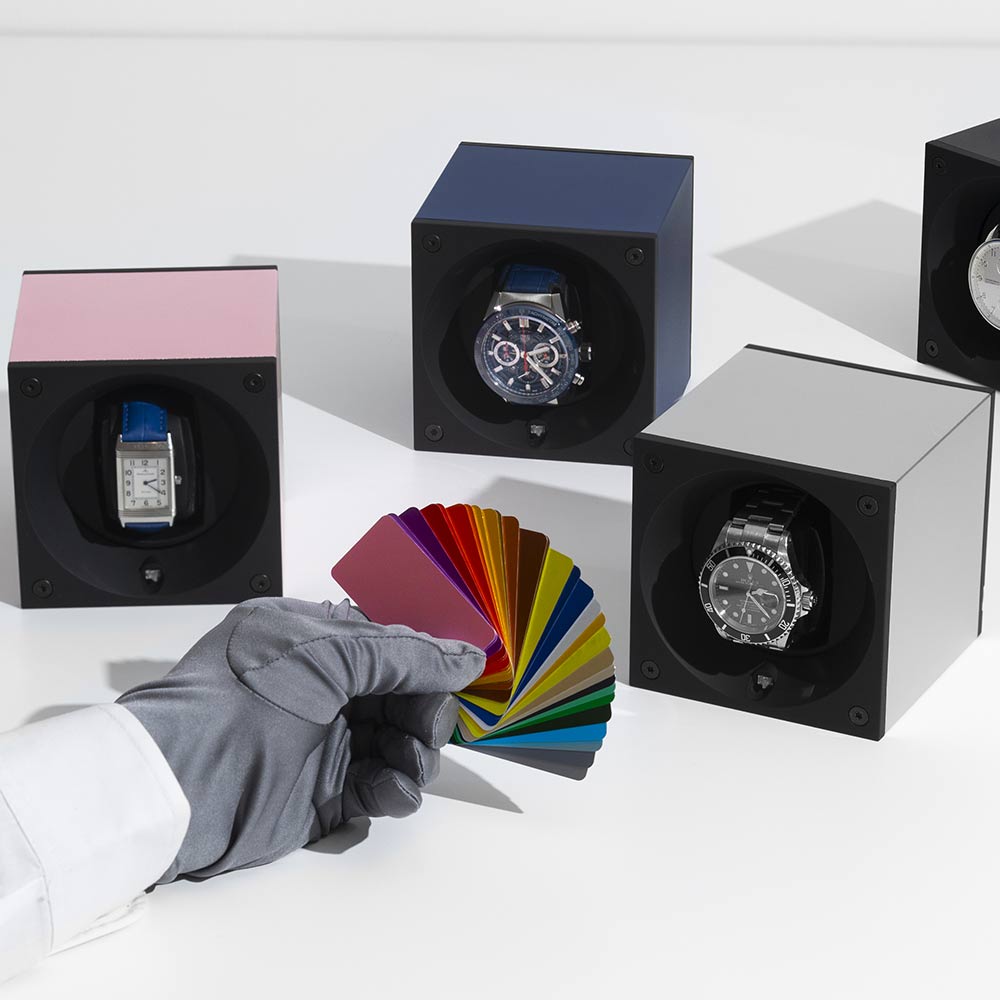
Handmade in the Givisiez manufacture in Switzerland, Swiss Kubik watch winders are the only ones to have been officially approved by Rolex. Their direct-drive motor — with no belt — guarantees maximum reliability and silent operation.
Another unique technical advantage: certified magnetic neutrality at 0.07 mT — 85 times below the ISO 764 standard. Your timepieces remain protected from any magnetic disturbance, however long they are used.
The Swiss Kubik StartBox watch winder
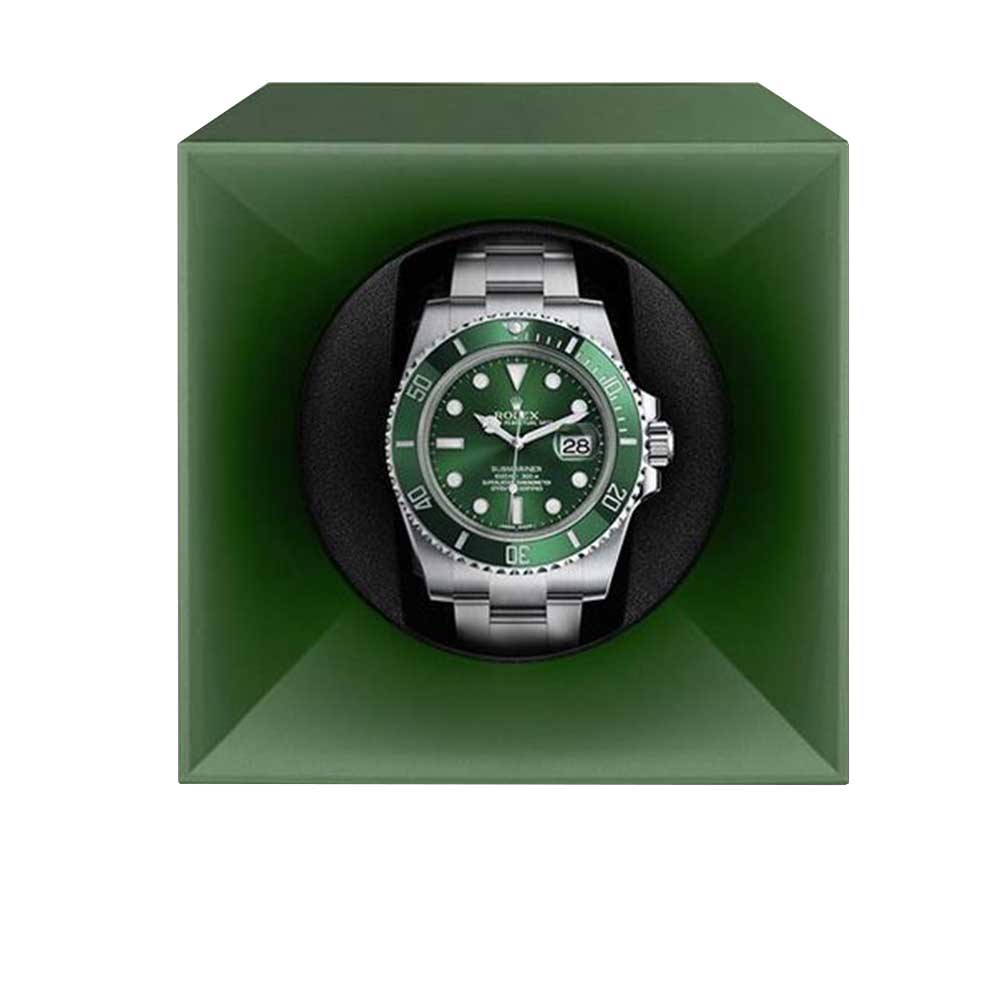
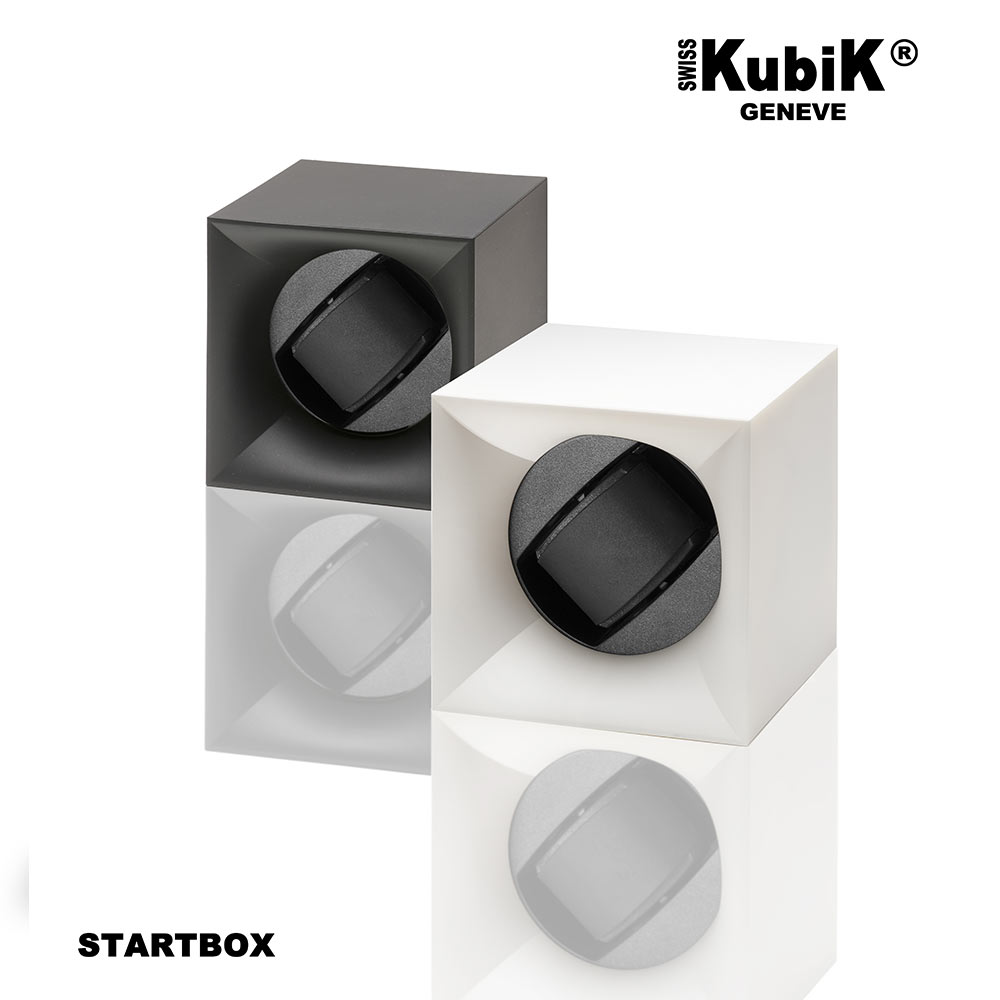
The entry point to the Swiss Kubik range. Fixed programme of 1,600 turns per day, Soft Touch ABS finish, available in a wide choice of colours. Ready to use as soon as it is switched on. Procell LR14 batteries supplied, 2 to 3 years of autonomy.
The Swiss Kubik Masterbox: the programmable reference
Anodised aluminium case (anodising treatment) or genuine leather covering. Programmable via Bluetooth and USB-C from your smartphone (iOS and Android). Automatic mains / battery detection. Default programme: 1,600 turns per day — fully reconfigurable. Rolex approved.
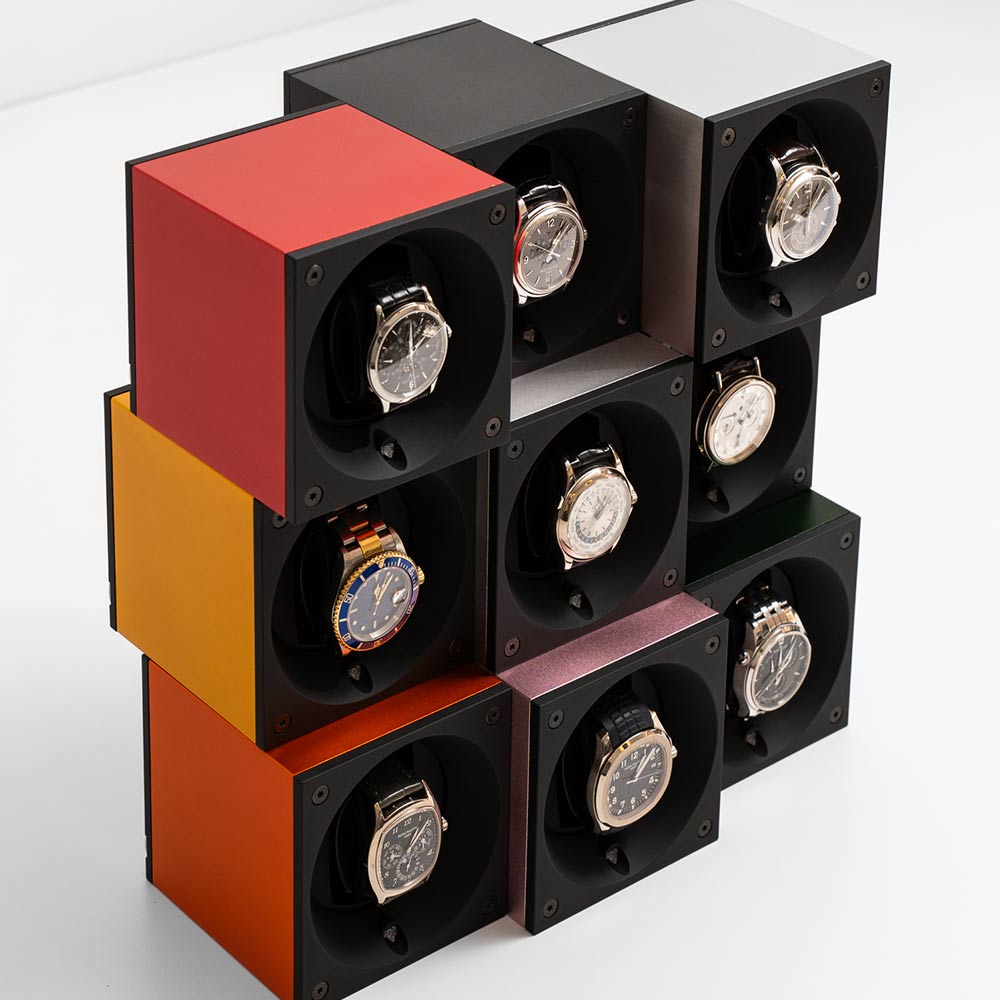
View the Swiss Kubik Masterbox
Rapport London EVO MK3: the best value for money
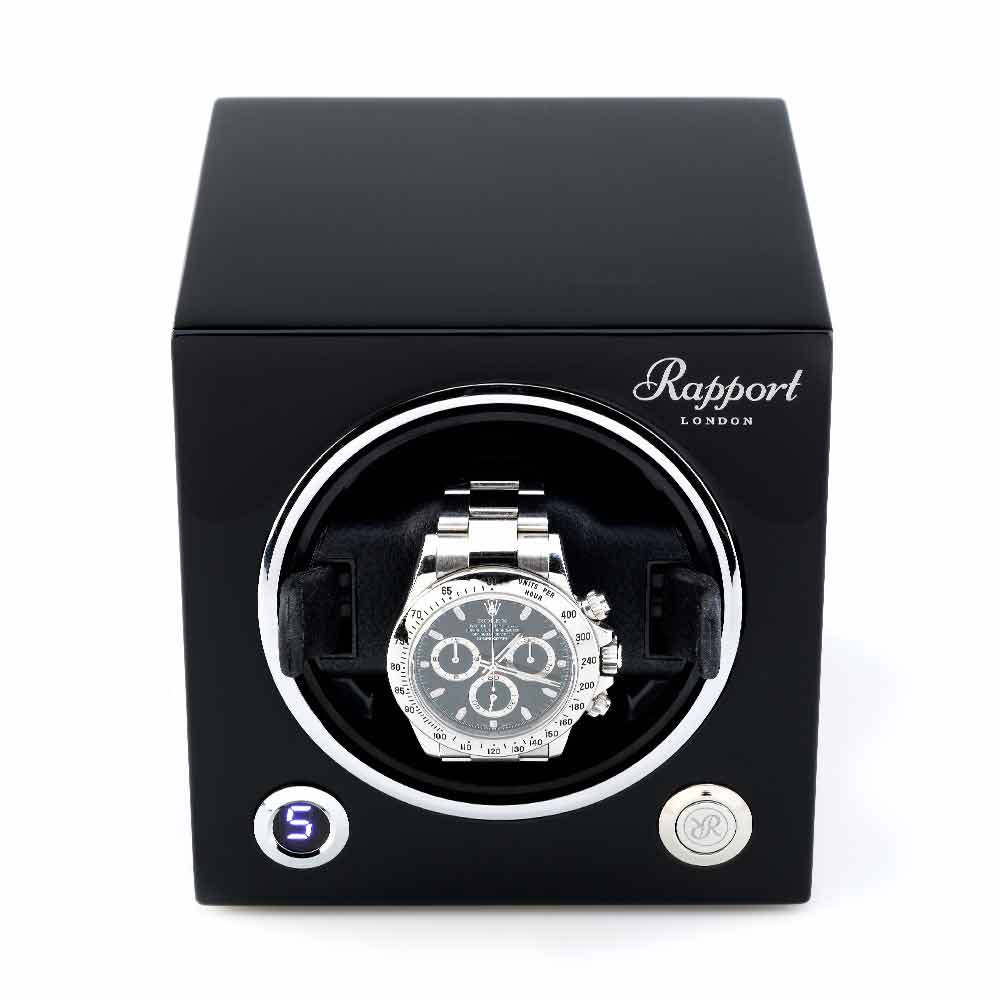
Founded in London in 1898, Rapport is a family house now in its fourth generation. The EVO MK3 cube is its best-selling model worldwide — and for good reason: multi-layer piano lacquer finish, hand assembly, silent direct-drive motor.
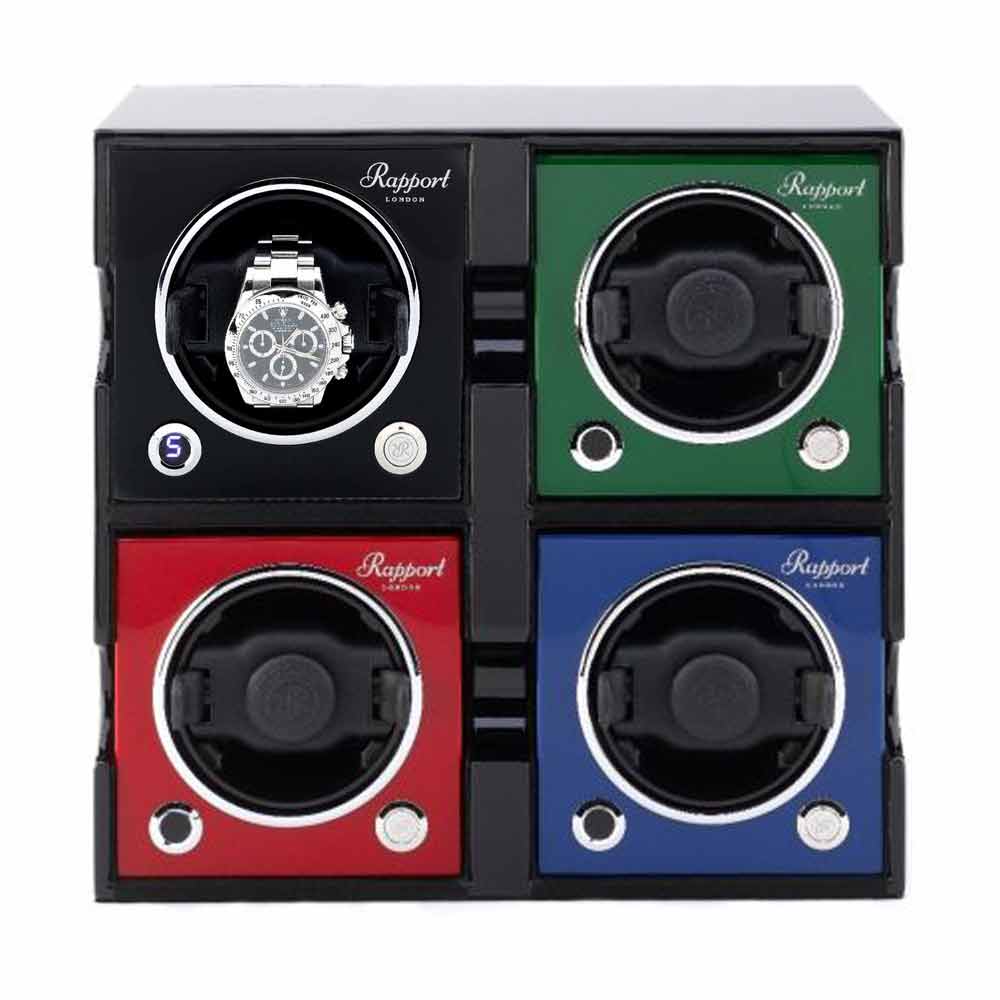
9 preset programmes, including programme 6 at 900 turns per day bidirectional, recommended for Rolex and Omega. Compatible with mains power and LR14 batteries (more than 18 months of autonomy). Can be assembled in modules of 2 or 4 units.
View the Rapport London EVO MK3
The EVO MK3 watch winder is available in 9 colours, including Rolex Racing Green — a signature shade inspired by the Rolex universe.
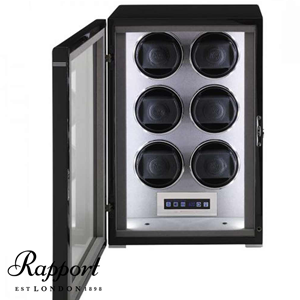
Rapport London Formula cabinets
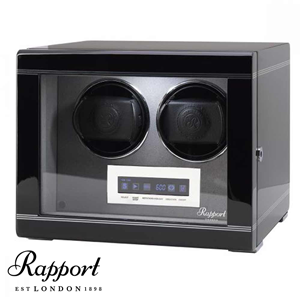
For larger collections: the Formula cabinets hold 2, 4 or 6 watches at once, with independent rotation programmes, a glass front and a key lock. Mains powered.
Scatola del Tempo by Swiss Kubik: Swiss technology in an Italian case
Acquired by Swiss Kubik in 2019, the Italian house Scatola del Tempo enjoys recognition from Patek Philippe and now uses Swiss Kubik motorisation. The perfect alliance between Italian craftsmanship and Swiss watchmaking technology.
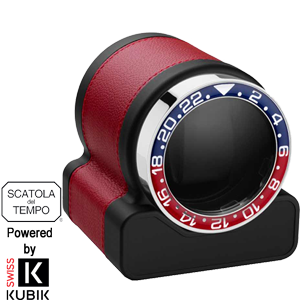
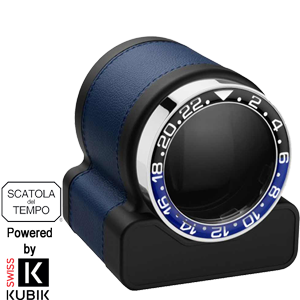
The Rotor One
Swiss Kubik motorisation, exceptional leather finish, glass front with coloured bezels echoing the great sports watches. 2 to 3 years of battery autonomy. 3-year warranty.
The 7RT cabinet
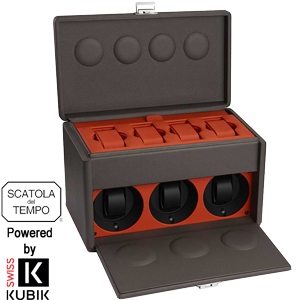
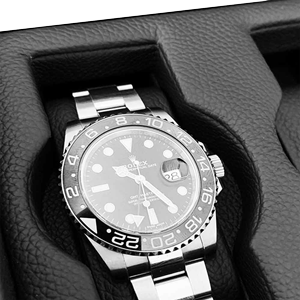
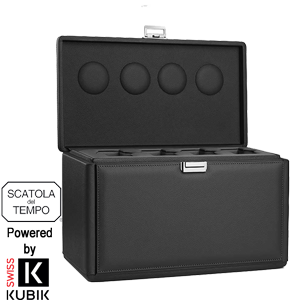
The pinnacle of the collection. A case covered in grained Italian leather, with 4 cushions in the upper section for your finest calibres and 3 Swiss Kubik Masterbox winders built into the lower section — each programmable individually via Bluetooth. More than 2 years of battery autonomy.
How to use a watch winder: the 4 steps
Setting up a watch winder takes less than two minutes. Here is the procedure, illustrated by our own workshop photographs.
1. Prepare the watch
Take your watch off your wrist and check that it is showing the right time. If it has stopped, wind it manually with around thirty turns of the crown and set it before placing it on the winder. A watch winder maintains an existing power reserve — it does not effectively restart a watch that has completely stopped.
2. Fit the watch onto the holder
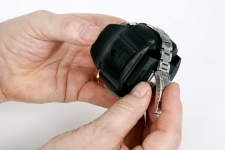
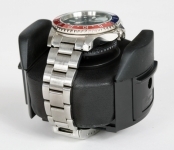
Remove the holder from the winder. Open the strap and wrap it around the cushion without forcing it: the watch should be held firmly, without excessive tension on the lugs. A strap that is too tight will deform the leather; too loose, and the watch will slip, making the winding irregular.
3. Insert the holder into the winder
Put the holder back into its housing, with the dial facing outwards. Check that it is properly engaged and that nothing rubs against the wall of the case.
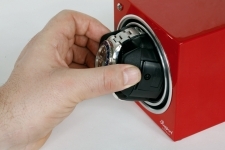
4. Select the programme and switch on
On a fixed-programme winder — Swiss Kubik StartBox, Scatola Rotor One — you simply switch it on: the 1,600 turns per day cycle begins. On a programmable model such as the Masterbox or the EVO MK3, select the number of turns and the direction of rotation suited to your calibre. Then leave the winder running continuously: the built-in rest phases protect the mainspring.
Unsure which programme suits your timepiece? Our team is available on +33 9 80 84 88 08.
A brief history of the watch winder
Self-winding mechanisms are far older than most people assume. The principle is said to date back to 1777, developed by Louis Perrelet. Production automatic watches, however, only began in 1926 — and the first watch winders appeared in their wake.
Rudimentary at first, these devices have evolved considerably. Today, watch winders combine precision engineering, contemporary design and fine materials — in a compact format with extended autonomy. They have become inseparable from any serious collection of automatic watches.
FAQ — Watch winder for automatic watches
Can a watch winder damage my watch?
No, provided you choose a quality winder with built-in rest phases. Swiss Kubik, Scatola del Tempo and Rapport London winders are approved by the great watchmaking houses and present no risk to your timepiece.
Should the watch winder be left on permanently?
Yes. A winding cycle with rest phases keeps the mainspring at a constant, intermediate tension — healthier for the movement than a complete stop followed by a restart. Power consumption is minimal (2+ years on batteries for Swiss Kubik and Rotor One).
Can my watch winder wind every brand of watch?
Yes. The standard bidirectional programme of 1,600 turns per day is compatible with 90% of automatic watches — Rolex, Omega, IWC, Breitling, TAG Heuer, Patek Philippe, Audemars Piguet. For watches requiring a specific programme, the Masterbox allows a bespoke configuration.
What is the difference between a watch winder and a watch charger?
There is none — they are two terms for the same object. "Automatic watch charger" is sometimes used by newcomers; the correct term is "watch winder".
Is a watch winder noisy?
Swiss Kubik, Scatola Rotor One and Rapport London watch winders are known for their silent operation. Their direct-drive motor (with no belt) produces a sound that is imperceptible in normal use. They can be placed in a bedroom without disturbance.
Which watch winder for a Rolex Submariner?
The Swiss Kubik StartBox, the Scatola Rotor One or the Masterbox — all three Rolex approved, with the 1,600 turns per day programme. The Rotor One in black leather or Rolex Green pairs particularly well with a Rolex.
Which watch winder for several watches?
The Rapport London EVO MK3 is modular: buy several individual cubes and assemble them in a 2 or 4 position frame. For an all-in-one luxury solution, the Scatola del Tempo 7RT holds 3 watches at once in a hand-covered leather case.
Our selection of watch winders
- All watch winders
- Swiss Kubik StartBox
- Scatola del Tempo Rotor One
- Swiss Kubik Masterbox
- Rapport London EVO MK3
- Scatola del Tempo 7RT
Follow La Boîte à Montres on social media:


Follow our news, our Swiss Kubik, Scatola del Tempo and Rapport London watch winders, and our expert advice on Facebook and Instagram.
Need personal advice?
Our team is available every day from 10am to 8pm to help you with your choice.
By e-mail: serviceclients@laboiteamontres.com
By telephone: +33 9 80 84 88 08