

NATO Strap: History, Military Origins and James Bond
In 1973, the British Ministry of Defence commissioned a strap capable of withstanding any condition — and of keeping the watch on the wrist even if a spring bar broke. This woven nylon strap, originally designated G10, would become one of the most iconic accessories in world watchmaking. Discover its history and browse our NATO strap collection.
The NATO strap: a piece of history worn every day
Few watch accessories can claim such a trajectory: born in the ranks of the British Army, popularised by James Bond, adopted by Rolex and Omega collectors, the NATO strap is today one of the most widely worn watch straps in the world — and one of the very few to cross the decades without dating.
Its strength? A pass-through design that puts safety first, a military nylon that will not deform, and immediate stylistic legibility. Plain or striped, single colour or two-tone, it suits every timepiece and every personality.
Browse our full selection: NATO straps — available in 18, 20, 22 and 24 mm, in a wide range of colours.
1973: the British military origin
The story begins in 1973 in the United Kingdom. The British Ministry of Defence set out to equip its soldiers with a strap that was reliable, robust and inexpensive, capable of withstanding the harshest conditions.
The straps of the time had three major limitations:
- Leather absorbs moisture and deteriorates quickly under perspiration or immersion
- Rubber lacks reliability over time
- On a conventional strap, a single broken spring bar is enough to lose the watch
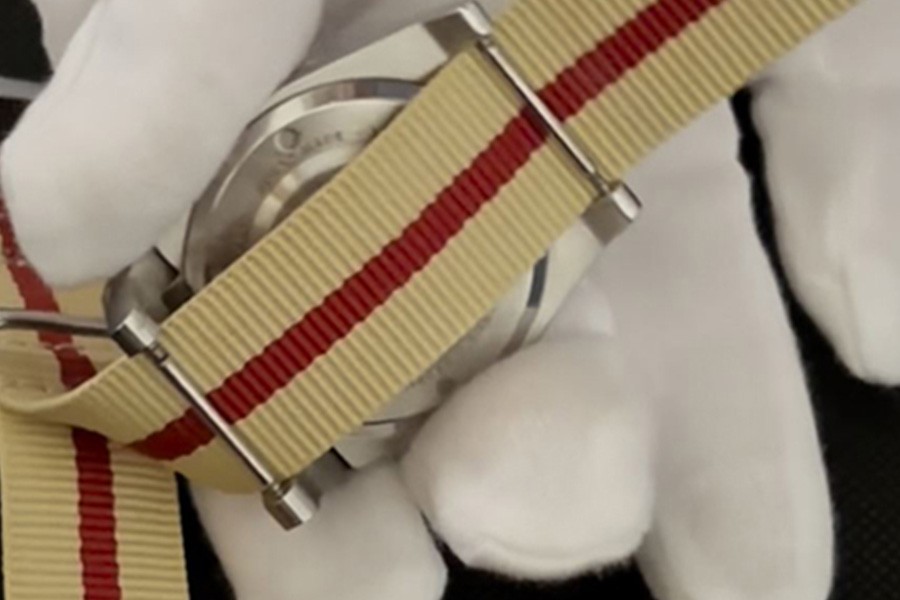
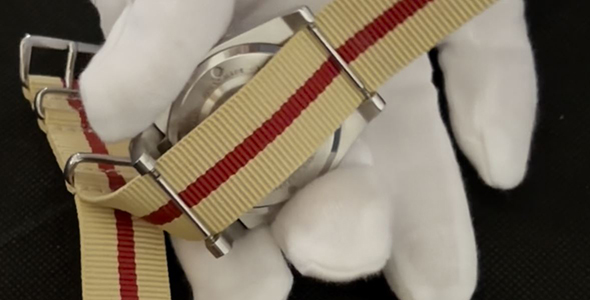
The solution developed by British military engineers rested on a high-strength woven nylon and, above all, on an unprecedented pass-through design: the strap runs beneath the watch case. That way, even if one of the stainless spring bars were to fail, the watch would remain firmly held on the wrist by the second bar.
This technical innovation — simple, effective, repeatable — is still today the main reason divers, service personnel and demanding sportspeople wear a NATO strap.
G10, NATO: where does the name come from?
When it was created, this strap was not officially called NATO. British soldiers obtained it through a military requisition form designated G10 — hence the name G10 strap, still used by purists.
The term NATO gradually took hold in the watch world, in reference to the logistical codifications of the North Atlantic Treaty Organisation. Over time the name became general, and today it covers virtually every nylon strap inspired by the original British military model.
The spirit remains unchanged: simplicity, robustness, effectiveness.
James Bond and the NATO strap: a legendary pairing
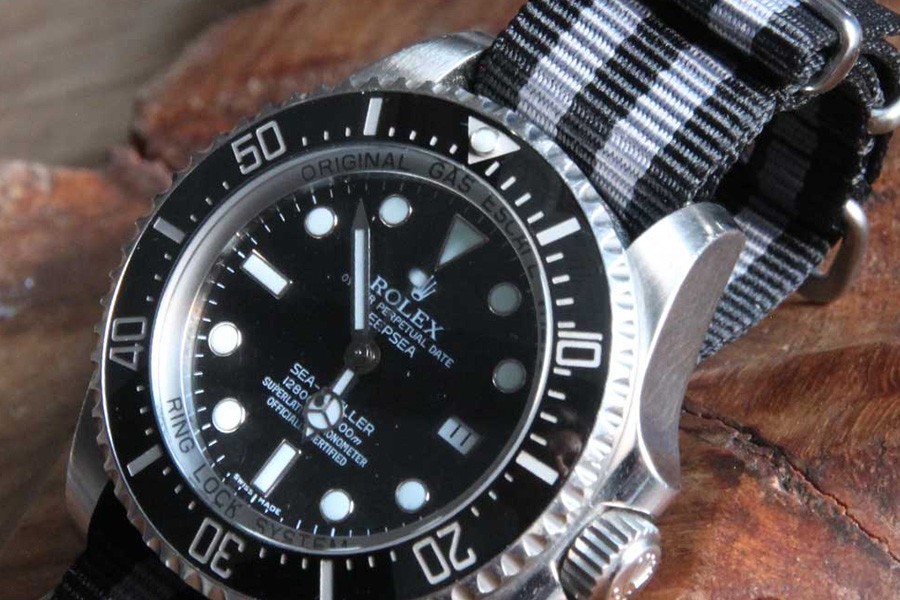
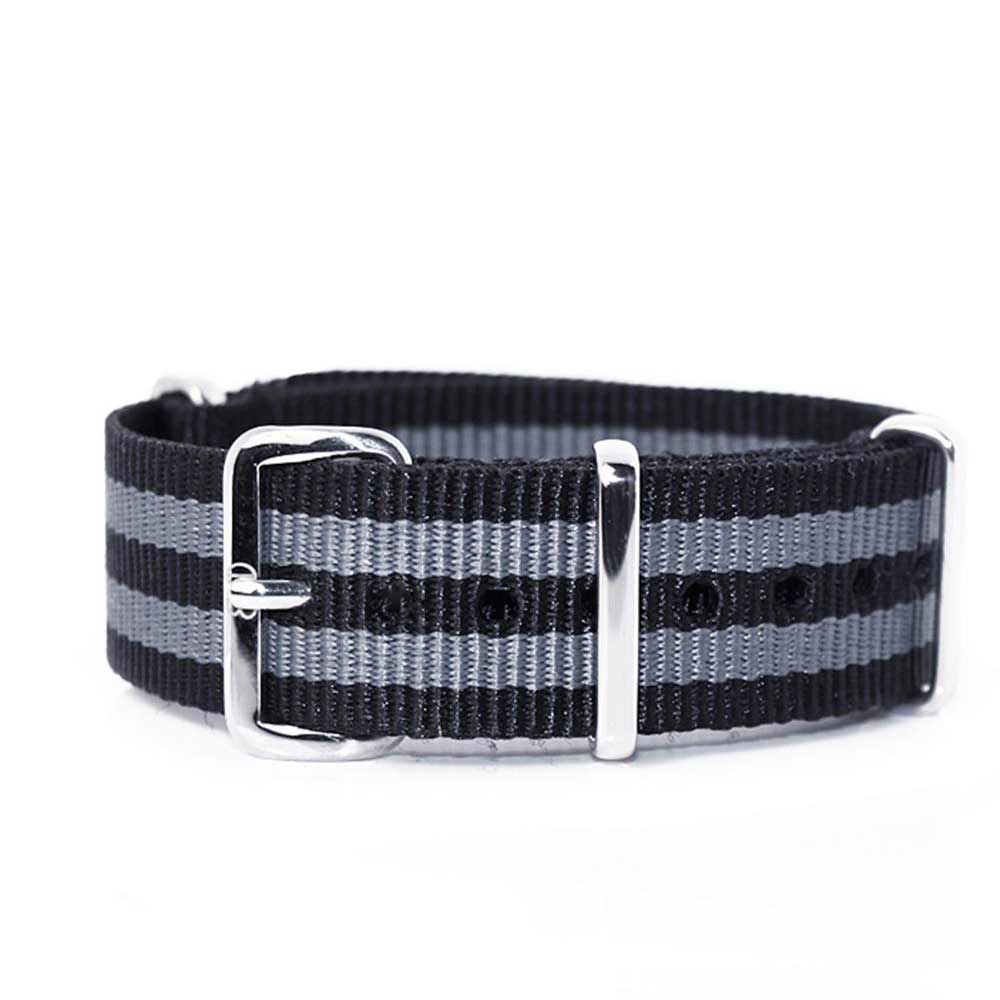
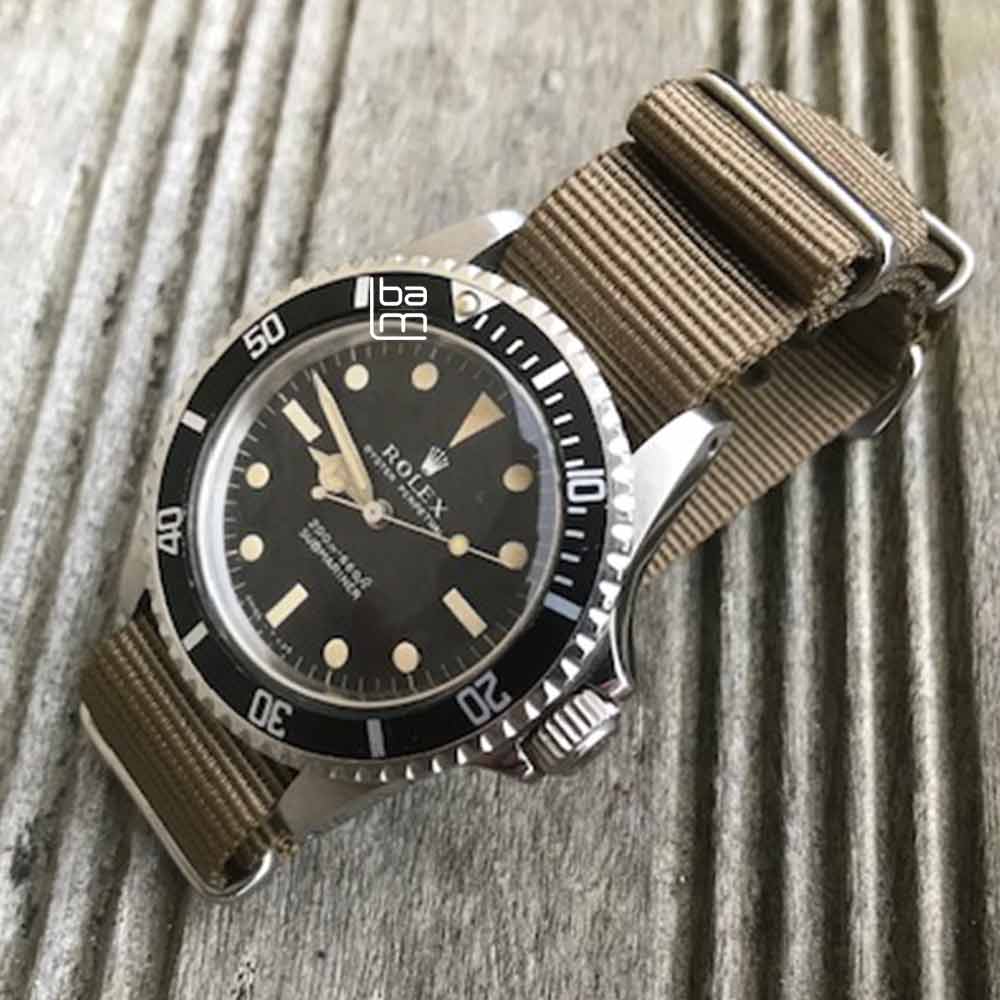
If the NATO strap is known far beyond watch circles, it is largely thanks to James Bond. As early as 1964, in Goldfinger, Sean Connery wore his Rolex Submariner on a black and grey striped strap. That strap did not yet match the British military standard formalised in 1973, but it is its direct ancestor and it left a deep mark on the collective imagination.
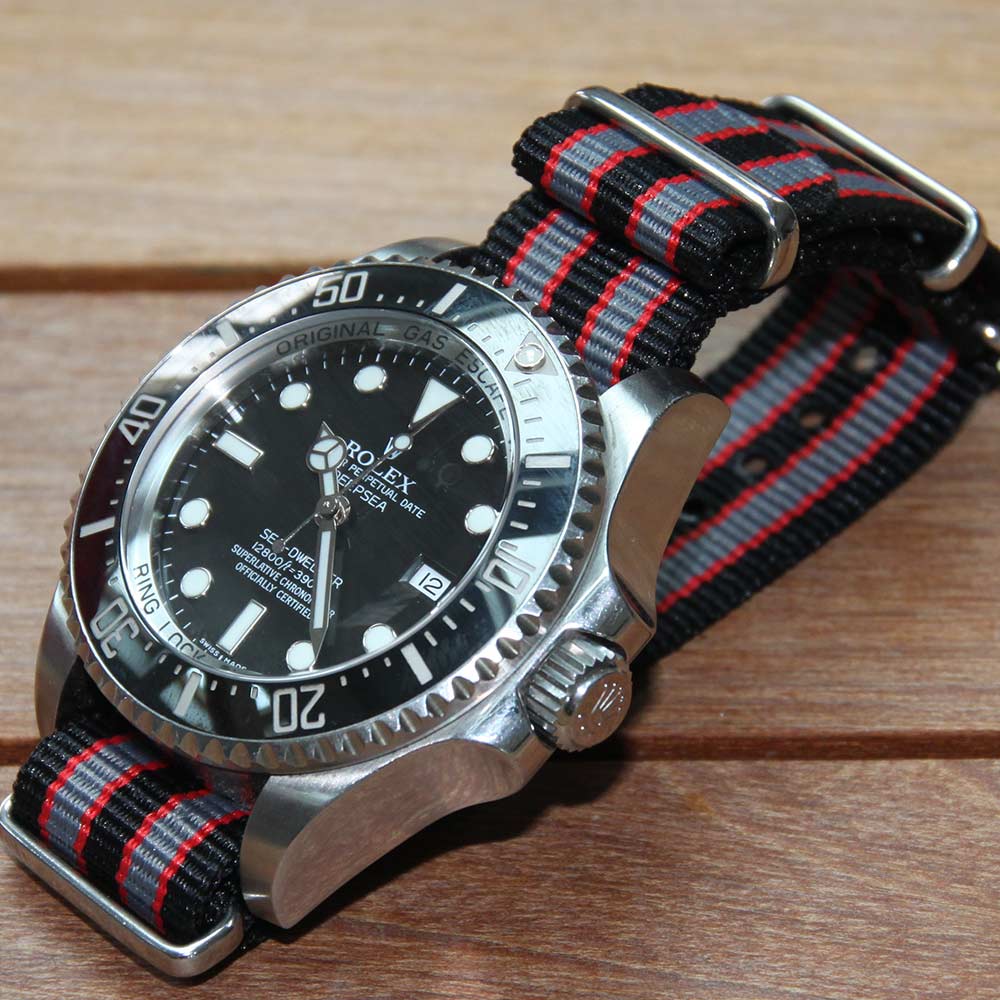
The pairing of the Rolex Submariner with the black and grey James Bond stripe has become one of the most sought-after combinations among collectors — well beyond the film itself. The emblematic colourway reappears in Spectre, Quantum of Solace and several other instalments of the franchise.
Our reference model inspired by that legend:
NATO James Bond black grey strap 20 mm
The technical strengths of the NATO strap
Safety beyond conventional straps
The pass-through design is the NATO's most decisive technical advantage. On a traditional strap, a broken spring bar means the watch falls immediately. On a NATO strap, the watch remains held by the second pass of nylon beneath the case — passive, permanent safety, with nothing to operate.
The double pass does need to be fitted correctly: that is what separates a properly mounted NATO from one that has simply been threaded through. Our video guide covers the fitting step by step, on a Rolex GMT then on a dive watch — how to fit a NATO strap.
A military nylon that will not deform
The nylon used for NATO straps is woven to resist seawater, perspiration, UV and repeated impact. It dries quickly, holds its shape, and is easily cleaned with warm water and mild soap. Some models even withstand a gentle machine wash inside a protective bag.
A marine-grade stainless buckle and keepers
The pin buckle and keepers are in marine-grade stainless steel — corrosion resistant, light, and sized to suit every wrist from 16 to 24 cm in circumference. That detail is what allows a NATO strap to be worn over a diving suit.
Unbeatable value for money
Changing the look of a collector's watch has never been so accessible. A NATO strap transforms a timepiece for under €20 — and collectors often own several, to vary the style with the seasons and the outfit.
Which NATO strap width should you choose?
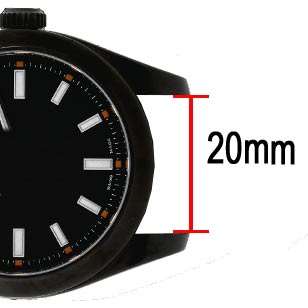
The width of the NATO strap must match the lug width of your watch exactly — the distance between the two lugs of the case, measured in millimetres. An error in width makes fitting impossible.
The four widths available on our site:
- NATO straps 18 mm — vintage watches, dress watches, moderately sized chronographs
- NATO straps 20 mm — the most common width: Rolex Submariner, Omega Seamaster, Omega Speedmaster, Hamilton Khaki Field, Seiko SKX
- NATO straps 22 mm — modern large-diameter sports and dive watches, for example the Jaeger-LeCoultre Master Compressor
- NATO straps 24 mm — large military watches, Panerai, adventure watches
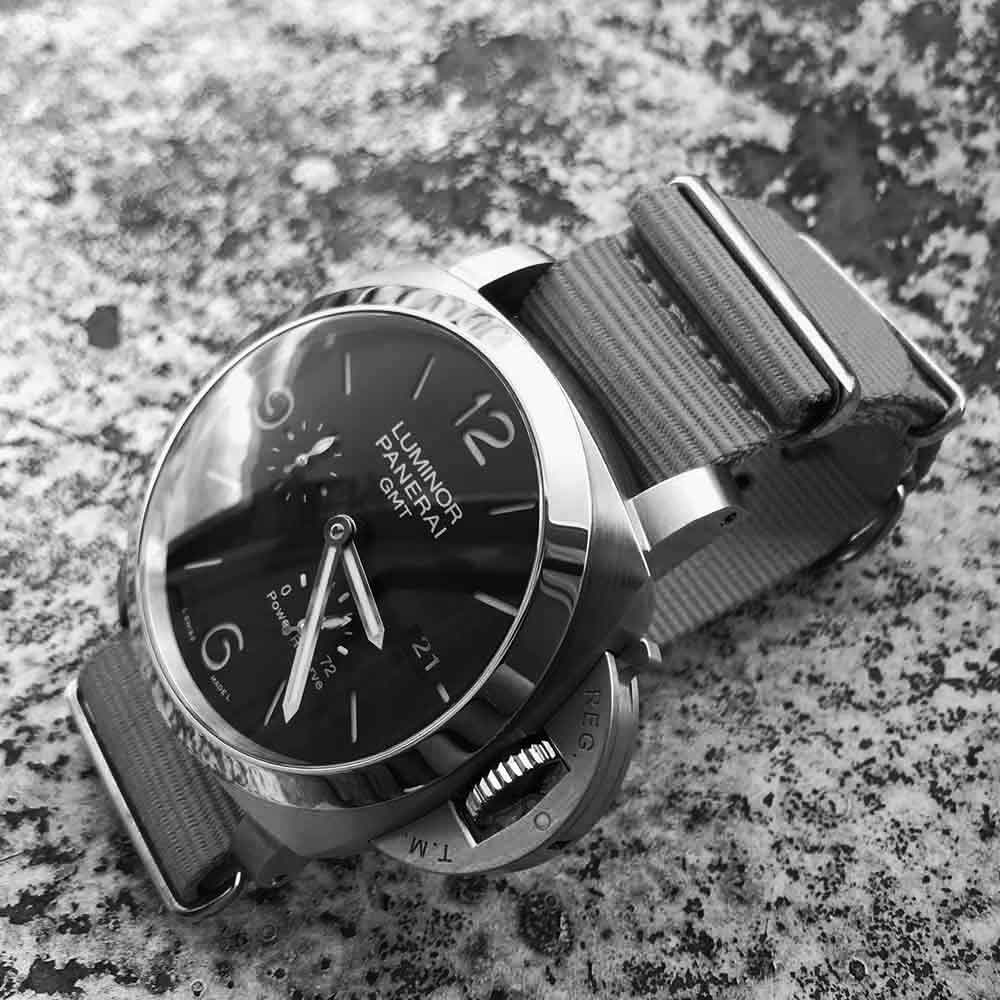
If in doubt, measure the lug width with a vernier caliper or check the technical sheet of your watch. The width is always given in the case specifications.
Don't know your watch's lug width? Our watch strap size guide explains how to measure it and gives the figures for 245 models, from the Rolex Submariner to the Seiko SKX.
NATO straps and Rolex watches
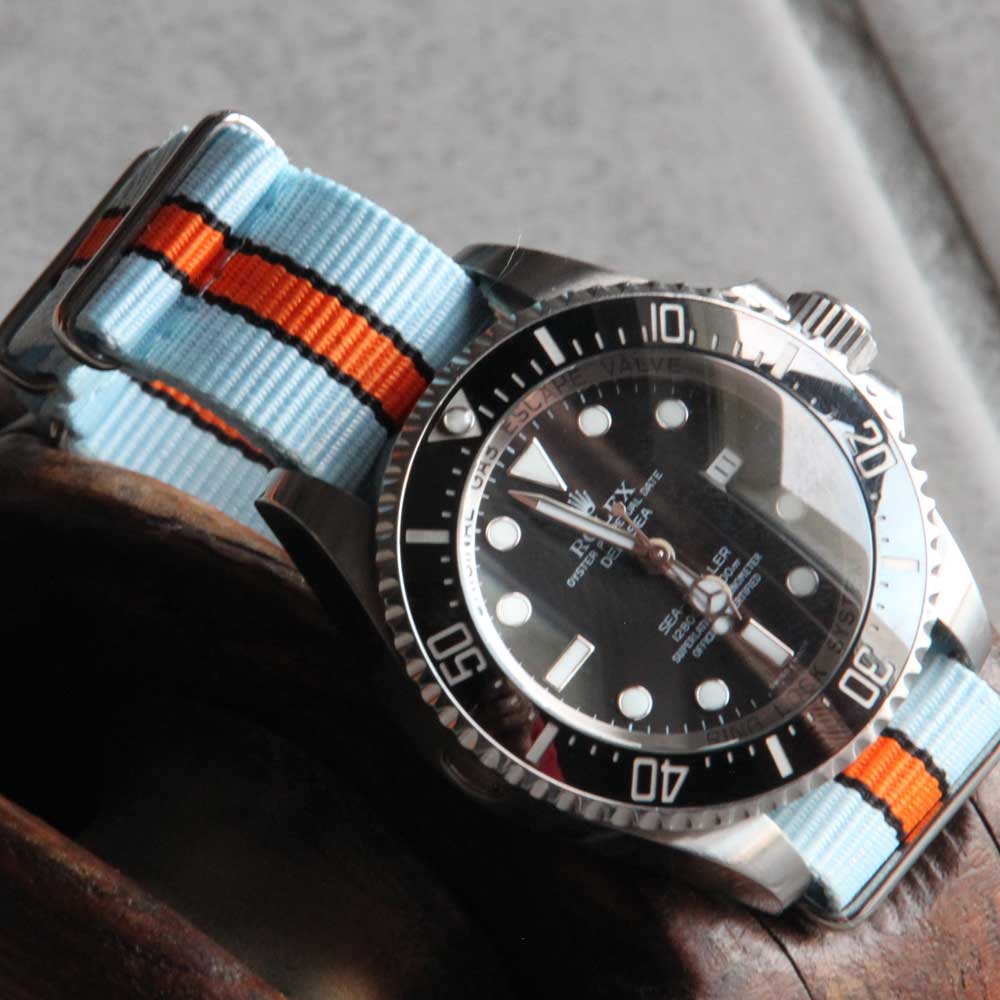
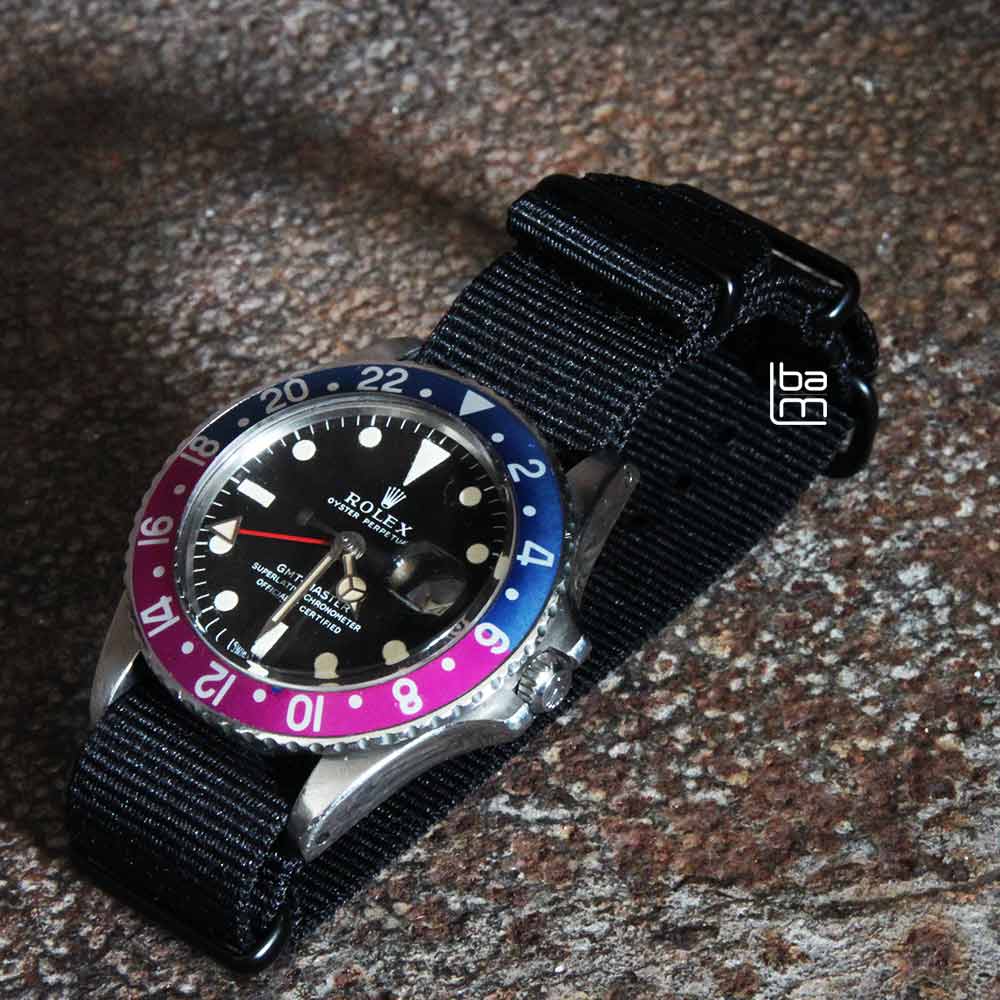
The pairing of Rolex and NATO strap is one of the most natural in contemporary watchmaking. Collectors value the ability to transform the look of a prestige timepiece completely, without touching the watch itself.
The Rolex models most often worn on a NATO strap:
- Rolex Submariner — the black and grey James Bond combination remains the absolute reference
- Rolex GMT-Master II — navy, red and blue, or khaki bring an adventurous character
- Rolex Explorer — understated and legible, it pairs perfectly with a black or green NATO
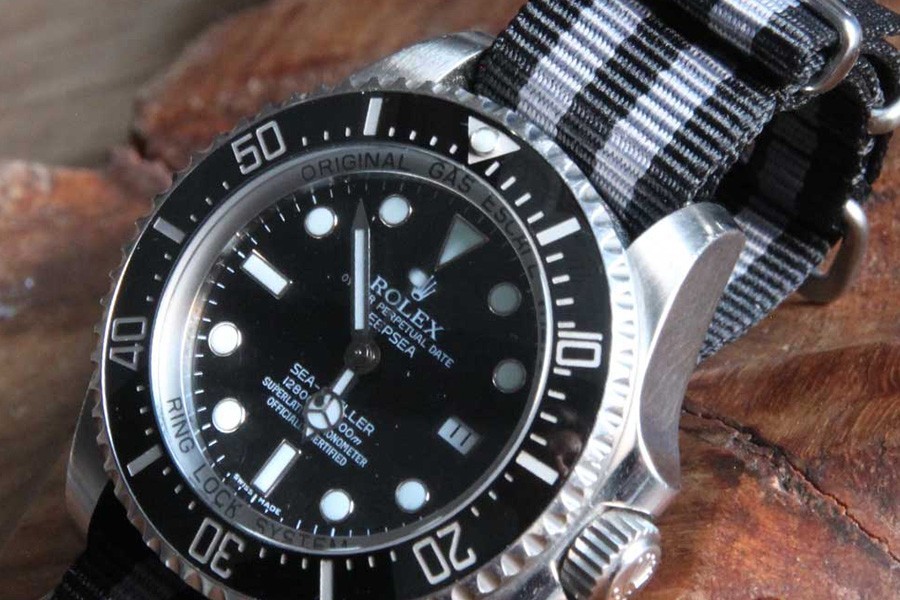
- Rolex Sea-Dweller — the ruggedness of the NATO naturally complements this extreme dive calibre
- Rolex Milgauss — a contemporary, offbeat touch with a coloured NATO
NATO straps and Omega watches
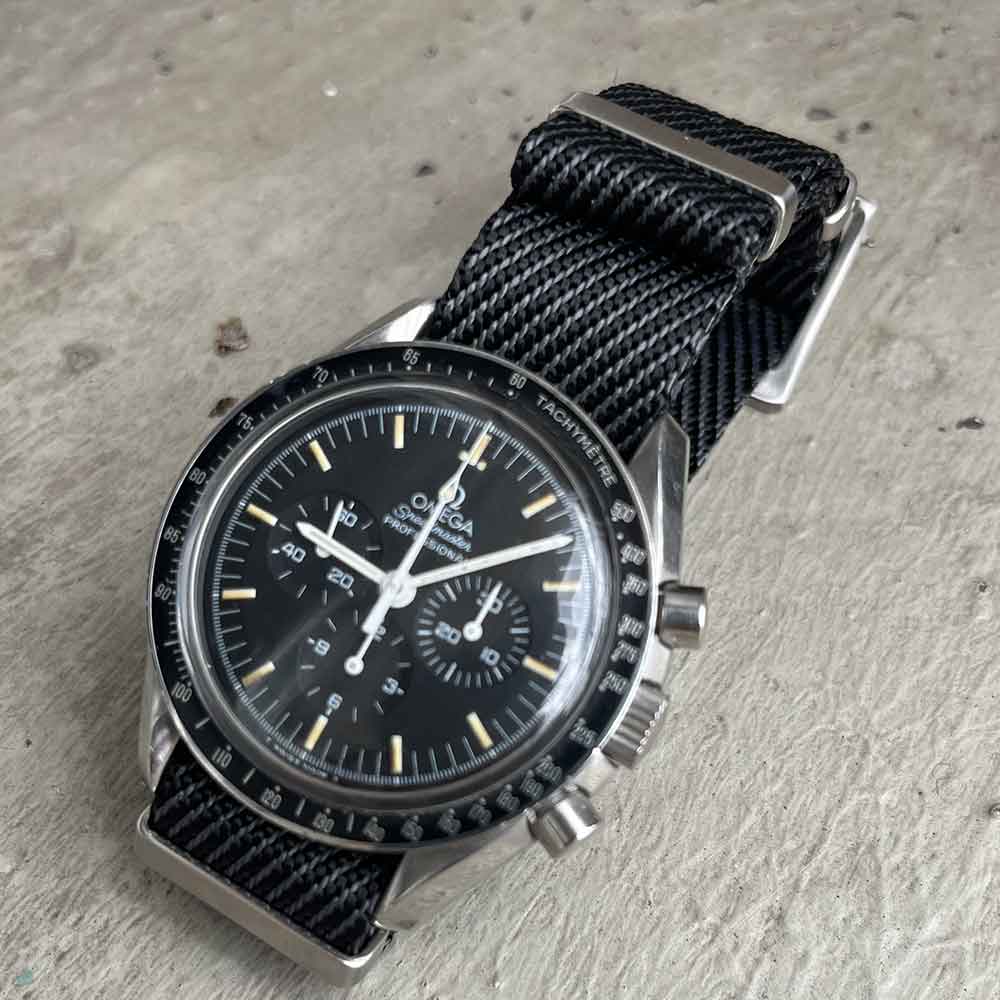
Omega has a historic relationship with the NATO strap. The Swiss brand offers its own collections of textile straps inspired by the original military model — a sign that the pairing is fully recognised by the great watchmaking houses.
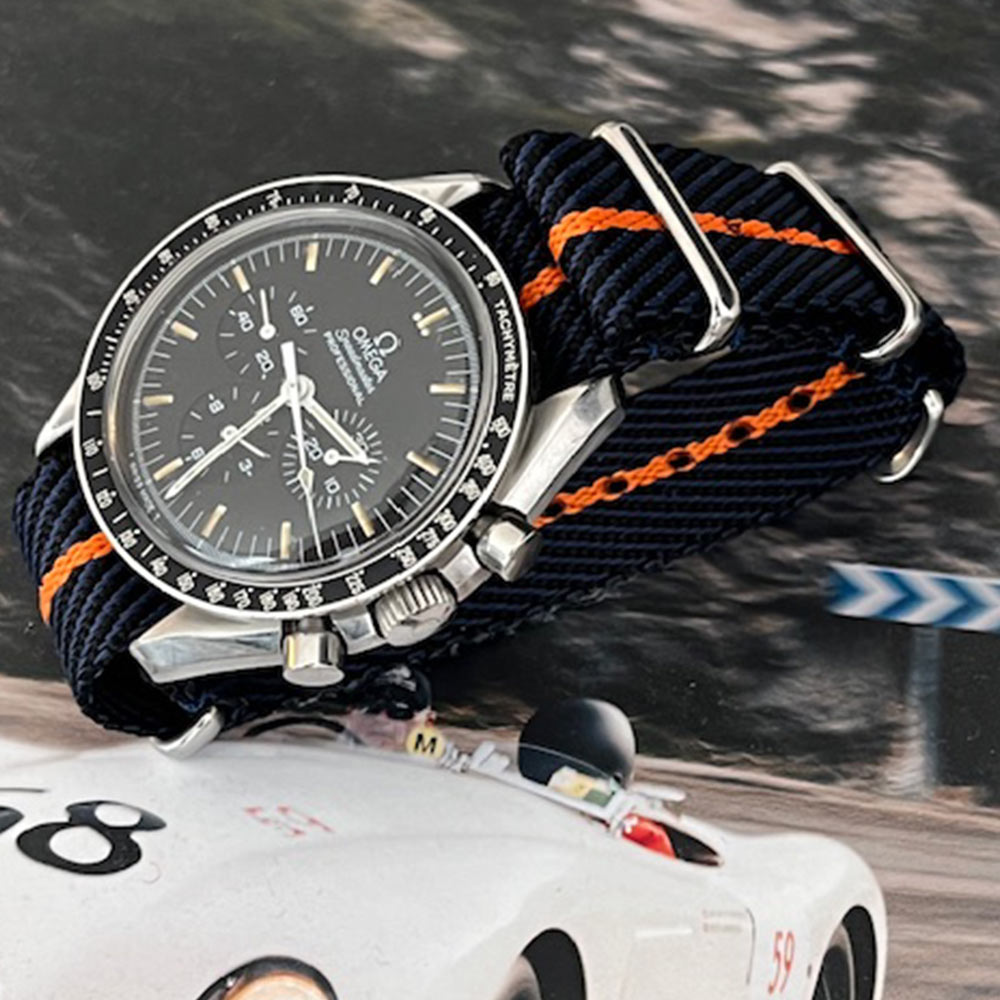
On an Omega Seamaster, the NATO reinforces the maritime, sporting character of the watch. On a Speedmaster — the icon of space exploration worn by NASA astronauts — it brings a more relaxed, contemporary touch while remaining faithful to the model's adventurous DNA.
The most sought-after colours on Omega: navy blue, anthracite grey, plain black.
Tudor, Hamilton, Seiko: other natural pairings
While Rolex and Omega account for most searches, other watches sit just as well on a NATO strap:
- Tudor Black Bay — the vintage, military inspiration of this watch makes it an ideal candidate for a striped or khaki NATO
- Hamilton Khaki Field — among the most legitimate watches for a NATO, its American military DNA is directly linked to the world of the G10 strap
- Seiko Prospex and Seiko 5 Sport — ruggedness, versatility and excellent value: the perfect trio with a NATO
NATO, leather or steel: how to choose?
The choice of strap depends on the use, the watch and the look you are after.
- Leather strap — elegance and refinement for dress watches, but sensitive to moisture and perspiration
- Steel bracelet — durability and a premium look, but heavier and more expensive
- NATO strap — water resistance, simple upkeep, a wide choice of colours, quick changes, pass-through safety. The most versatile solution for daily or sporting use
Many collectors alternate between the original steel bracelet and a NATO according to the season — steel for dressier occasions, NATO for everyday and weekends.
The most popular NATO strap colours
The black and grey striped James Bond NATO
The essential one. Its association with Sean Connery's Rolex Submariner in Goldfinger gives it a uniquely iconic status. It is often the first NATO a collector buys.
→ NATO James Bond black grey strap 20 mm
The plain black NATO
Understated, elegant, versatile. It works with practically every watch and every outfit — from the dive watch to the dress chronograph.
The navy blue NATO
Ideal on dive watches and the Omega Seamaster. Sporting without being showy.
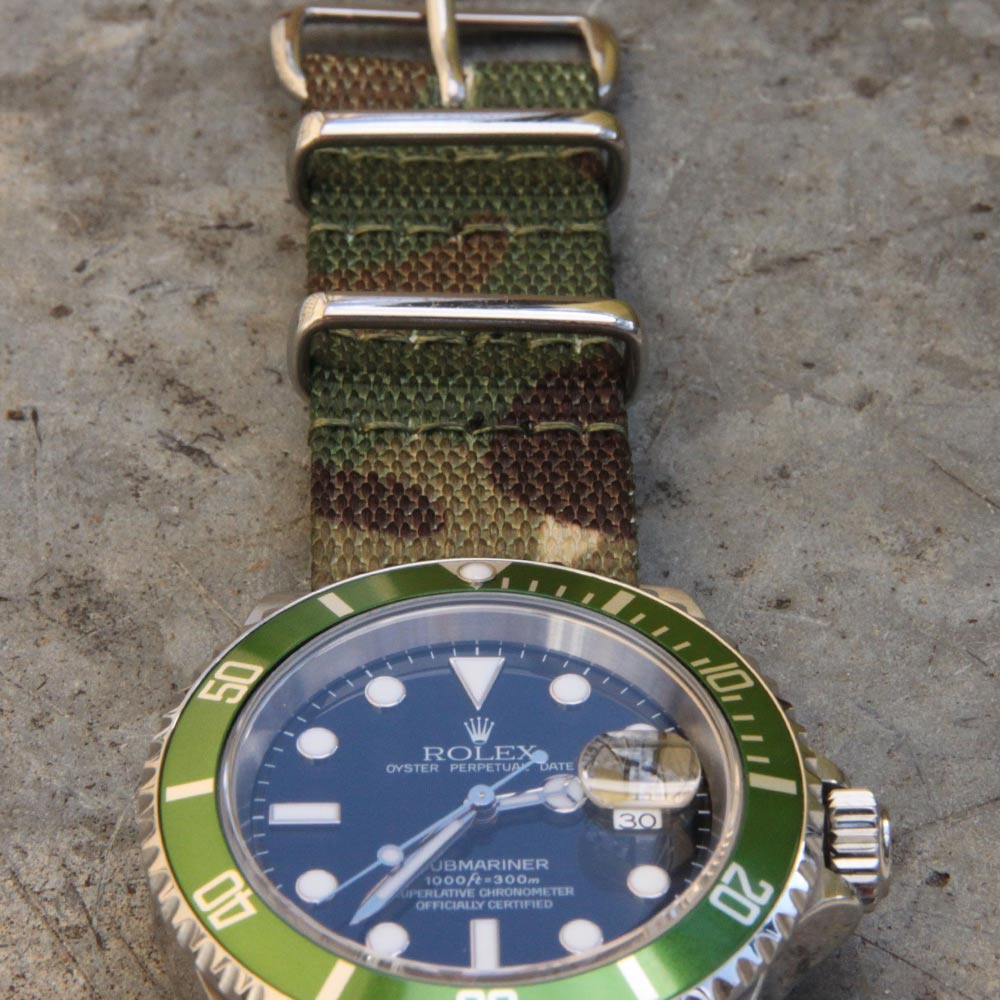
The khaki military NATO
Straight out of the military world. It pairs perfectly with Hamilton Khaki models, the Tudor Black Bay Heritage and Seiko field watches.
The grey NATO
An elegant compromise between plain black and two-tone. Modern, discreet, compatible with almost any dial.
Coloured NATO straps
Alongside the military classics, a whole family of bright colours has taken hold among collectors: Gulf blue and orange, light stripes, red, sky-blue James Bond. Worn in summer, on a dive watch or a steel chronograph, they transform the look of a piece for no more than a black strap costs.
This is where woven nylon shows its worth: it comes out of the water without marking, dries in minutes and returns to its original shade. We filmed our summer colours at the poolside, arm plunged into the water, to show how the material really behaves — Gulf blue and orange, red, light stripe and sky-blue James Bond.
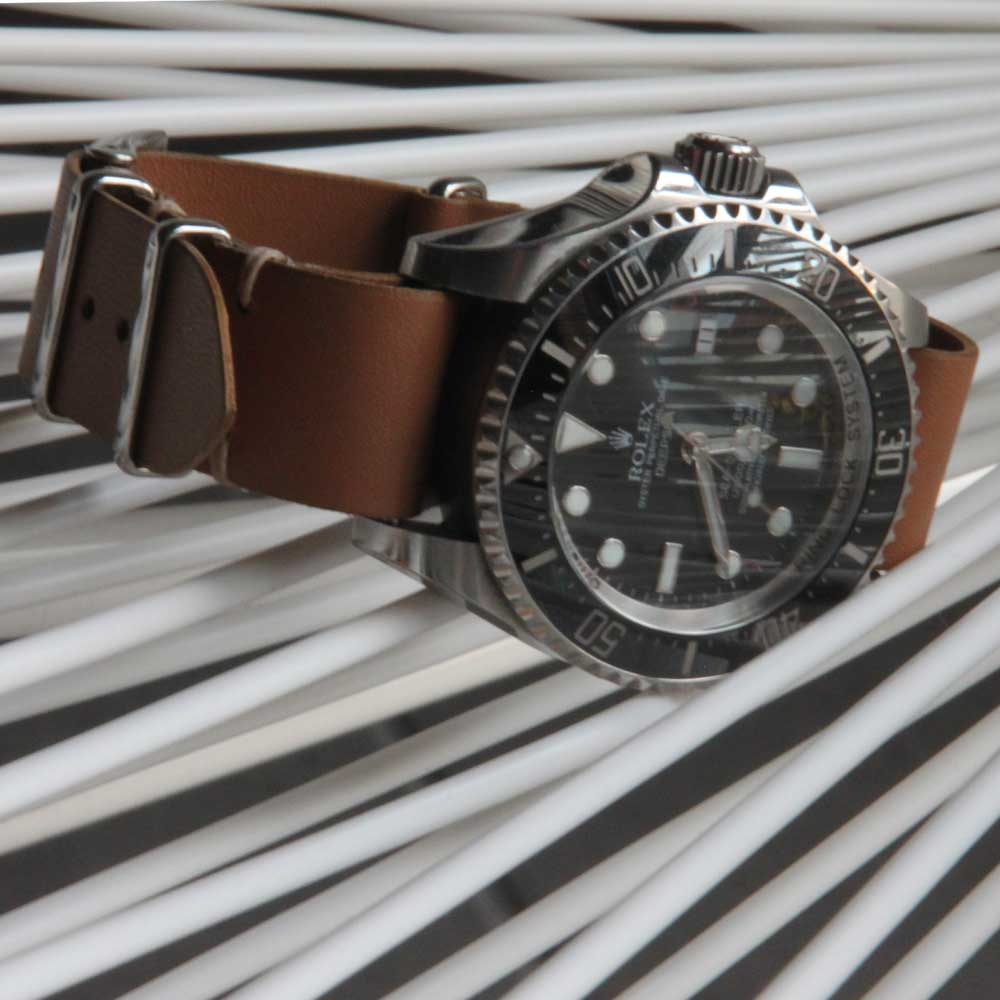
The leather NATO
More discreet, compatible with almost any dial provided its thickness stays very slim.
FAQ — Everything about NATO straps
Is the NATO strap waterproof?
Yes. The military nylon used stands up perfectly to both fresh water and seawater. It is one of the main reasons divers and watersports enthusiasts favour it.
Can you swim or dive with a NATO strap?
Absolutely. The NATO strap was designed for extreme operational conditions. It handles swimming, diving and intensive watersports without difficulty.
How do you care for a NATO strap?
A rinse in warm water with mild soap is enough for routine care. If heavily soiled, some models can be gently machine washed inside a protective bag. Air dry.
What is the most common NATO strap width?
20 mm is the most widespread width. It fits the great majority of sports and dive watches — Rolex Submariner, Omega Seamaster, Omega Speedmaster, Hamilton Khaki Field, Seiko SKX.
What is the difference between a NATO strap and a Zulu strap?
Both are woven nylon with a pass-through design. The Zulu strap uses thicker round rings and a generally heavier construction. The NATO keeps a slimmer profile, closer in look to the original British military model.
Is a NATO strap suitable for a luxury watch?
Yes, and that is precisely what makes it so successful. Many collectors wear their Rolex, Omega, Tudor or Breitling on a NATO strap. It brings a relaxed touch without diminishing the watch.
Which NATO strap for a Rolex Submariner?
The black and grey James Bond remains the absolute reference. Plain black and navy blue are also very popular.
Which NATO strap for an Omega Speedmaster?
Anthracite grey, plain black or navy blue sit particularly well with Speedmaster dials.
How long does a NATO strap last?
With normal use and regular care, several years. Its resistance to water, UV and perspiration contributes directly to its longevity.
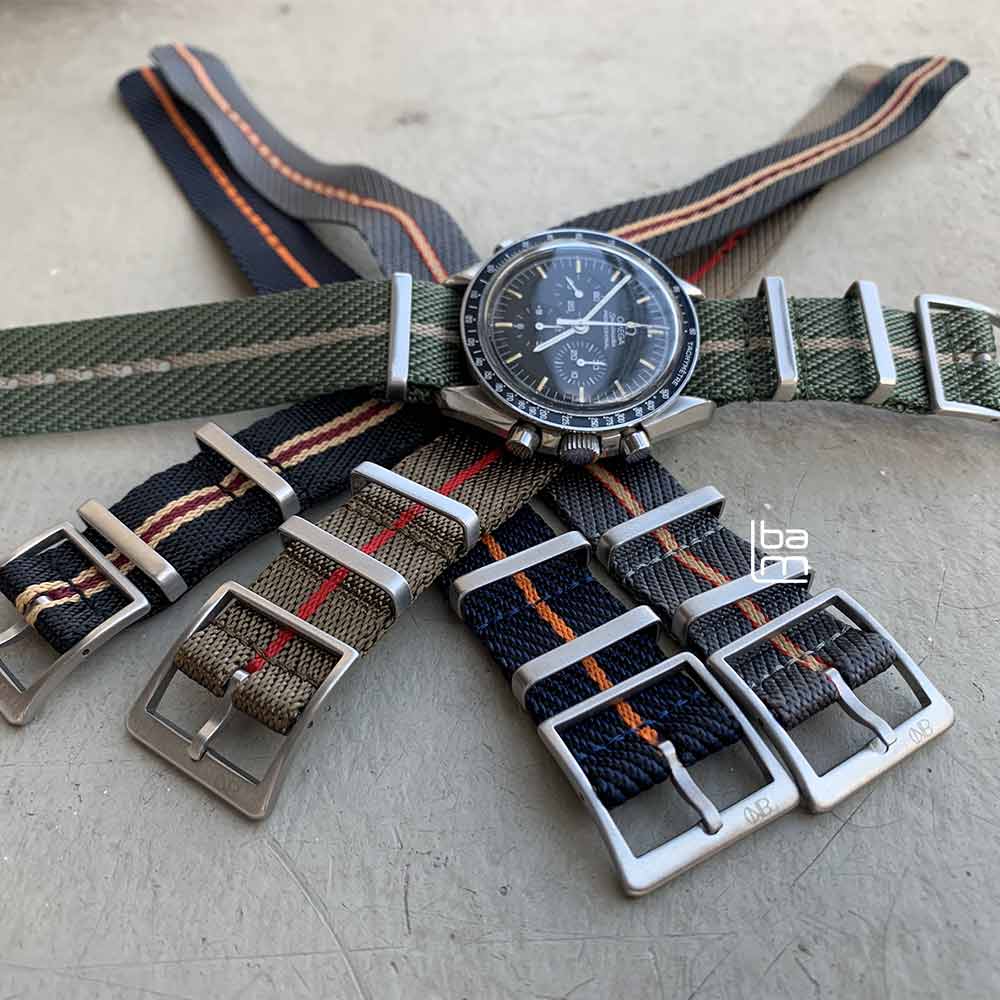
Our NATO strap selection
From the iconic James Bond model to the most contemporary colours, browse our full catalogue:
NATO James Bond black grey strap 20 mm
Going further:
How to fit a NATO strap — video guide
Removing a watch strap — video guide
How to choose a watch strap — size guide
Follow La Boîte à Montres on social media:


Follow our watch news, our new arrivals, our NATO straps, our watch winders and our expert advice on Facebook and Instagram.
About the author
Written by Sébastien Villeroy, founder of La Boîte à Montres in 2010. The products featured in our guides are handled, tested, photographed and filmed by our team.